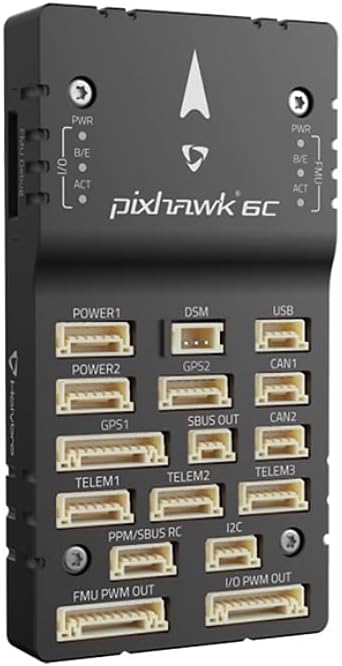
Pixhawk 6C Flight Controller
STM32H743 480MHz processor
Dual redundant IMU with temperature control
Integrated vibration isolation system
This guide compares the top flight controllers for hybrid VTOL and VTOL drones to help you choose the best autopilot system for stability and performance.
Selecting the right flight controller for hybrid VTOL and VTOL drones is critical for ensuring stable transitions and reliable autonomous flight. These systems must handle complex aerodynamics while maintaining precision control across multiple flight modes. A capable controller integrates advanced sensors and robust firmware to support seamless vertical takeoffs and efficient forward flight operations.
We evaluated ten leading flight controllers based on processing power, firmware compatibility, sensor redundancy, and support for VTOL configurations. Our analysis considers how each unit handles transition phases, its integration with popular autopilot software, and the ease of setup for builders. We focused on models that offer reliable performance for both hobbyist projects and professional applications.
Each selection in this guide highlights specific strengths such as open source support, modular design, or enhanced vibration isolation. You will find detailed breakdowns of specifications, connectivity options, and recommended use cases for every product listed. Please note that product availability and pricing may vary over time, so always verify current details before purchasing.

4.8Editor score
4.4Editor score
This side-by-side comparison highlights key specifications and capabilities across all ten selected flight controllers. Use this table to quickly assess processing power, sensor suites, and firmware options to find the best match for your VTOL build requirements.


The KK 2.1.5 Flight Control Board is designed for hobbyists seeking reliable stabilization and control for VTOL and V-Tail aircraft. It ensures excellent flight control capabilities and stability across various applications including aerial photography and skill showcasing. This controller supports self-leveling and acrobatic flights making it versatile for both learning and competition.
We may earn a commission when you buy through this link, at no additional cost to you.
Its advanced flight control technology provides an exceptional flying experience for users who want to explore flight control systems. The board is particularly well-suited for vertical takeoff and landing applications where stability and flexibility are paramount. It allows experienced individuals to perform challenging maneuvers adding excitement to their flying experiences.
While it lacks some advanced telemetry features found in higher-end units the KK 2.1.5 offers robust performance for its category. The simplicity of the system makes it accessible for those who prioritize straightforward operation without complex setup requirements. It serves as a solid foundation for hobbyists seeking advanced flight control features.
This controller is ideal for enthusiasts looking to customize their flight experience without a steep learning curve. Whether for competitions or personal projects it provides the necessary tools to manage VTOL configurations effectively. We recommend it for builders who value reliability and ease of use over extensive programmability.
The self-balancing feature ensures consistent flight even in challenging aerodynamic conditions typical of VTOL configurations.
Users can deploy this controller for model aircraft competitions or aerial photography projects with confidence.
We may earn a commission when you buy through this link, at no additional cost to you.
The COREWING F405 V2 Flight Controller is engineered to fit RC airplane and drone applications with precision. Its F405 processor core delivers the computational power needed for stable flight dynamics in various aerial platforms. This controller is optimized for builders who require reliable performance without unnecessary complexity.
We may earn a commission when you buy through this link, at no additional cost to you.
Its design focuses on compatibility with RC airplane configurations ensuring smooth transitions and stable hover capabilities. The unit integrates well into standard frames offering a clean layout for wiring and sensor placement. It is suitable for users who prioritize flight quality and responsive control in their builds.
While specific sensor details are minimal in the provided data the controller supports essential functions for autonomous and assisted flight. The compact design allows for easy integration into space-constrained builds. It offers a practical solution for those developing custom RC airplane or VTOL projects.
We recommend this controller for builders who need a dependable flight controller for fixed-wing or hybrid airframes. Its balance of performance and simplicity makes it a strong candidate for intermediate hobbyists. It is well-suited for projects requiring precise control over flight modes and stabilization.
The controller is tailored to handle the unique aerodynamics of fixed-wing aircraft effectively.
With an F405 processor it provides sufficient processing power for complex flight maneuvers.
We may earn a commission when you buy through this link, at no additional cost to you.
The PIX 2-12S Mavlink Flight Controller integrates high-quality sensors like the MPU6500 gyroscope and LPS22HB barometer for accurate flight data. It supports a wide voltage range from 2 to 12S making it compatible with various power systems. This controller is designed for VTOL and multirotor applications where precision is essential.
We may earn a commission when you buy through this link, at no additional cost to you.
Its connectivity options include GH1.25 connectors for GPS SBUS PPM and CRSF receivers ensuring broad compatibility with modern radio systems. The board is built to function as a core component for multi-rotor fixed-wing VTOL and DIY autonomous driving systems. It includes necessary wiring to streamline the installation process.
Users should note that the ESC is excluded from the package so additional motor control hardware must be sourced separately. The compact dimensions allow for integration into smaller frames while maintaining robust functionality. It is a practical choice for DIY projects requiring advanced sensor fusion.
We recommend this controller for developers and hobbyists building autonomous systems that demand reliable sensor input. The inclusion of standard protocols like SBUS and PPM ensures easy setup with existing equipment. It is ideal for those who want a solid base for complex VTOL configurations.
High-precision sensors ensure accurate flight data for stable autonomous operations.
Support for multiple receiver types simplifies integration with different radio systems.
We may earn a commission when you buy through this link, at no additional cost to you.
The Pixhawk 2.4.8 PX4 Open Source Flight Controller stands out as a reliable choice for beginners and developers alike. It features a high-end ARM Cortex M4 processor and includes a GPS combo for enhanced navigation capabilities. The controller enables autopilot or remote driving by connecting motors servos cameras and sensors seamlessly.
We may earn a commission when you buy through this link, at no additional cost to you.
Its open source nature allows hobbyists to carry out secondary development and customize functions to suit specific project needs. A quick start guide is prepared to assist new players with basic assembly and calibration of DIY drones. This approach ensures the system is easy to use for those new to flight controllers.
Quality assurance is maintained with inspections before shipment offering free repair or replacement within three months if issues arise. The controller supports rich function modules making it versatile for various platforms from fixed-wing to multi-rotor. It remains a strong option for those seeking a proven and supported system.
We recommend this controller for anyone entering the world of autonomous flight who values community support and documentation. Its balance of power and usability makes it a top pick for general purpose builds. It is particularly suitable for research and educational projects requiring reliable autopilot capabilities.
The included quick start guide simplifies the assembly and calibration process significantly.
Open source code allows developers to modify and extend functionality easily.
We may earn a commission when you buy through this link, at no additional cost to you.
The F405 Wing Flight Controller is designed for fixed-wing drones with VTOL capabilities offering versatile flight modes for diverse missions. It supports Ardupilot firmware which allows for advanced customization and high performance in autonomous operations. Users can easily configure and monitor flight parameters via smartphone using its APP control feature.
We may earn a commission when you buy through this link, at no additional cost to you.
With its F405 processor it ensures fast and stable processing for smooth flight experiences even in dynamic environments. The design is lightweight and compact minimizing added weight while maintaining robust functionality for various fixed-wing drone models. This flexibility makes it an ideal choice for different builds and user skill levels.
The unit is suitable for both beginners and experienced pilots due to its user-friendly setup and extensive feature set. Its compatibility with multiple models means it can adapt to different frame styles and motor configurations easily. This makes it a versatile option for those developing custom VTOL projects.
We recommend this controller for builders who value ease of configuration and smartphone integration. The combination of reliable hardware and flexible firmware support ensures a smooth flying experience. It is particularly well-suited for fixed-wing drones that require VTOL functionality and remote monitoring.
Monitor and adjust flight parameters easily using a dedicated mobile application.
Compact size reduces overall weight allowing for better flight efficiency and range.
We may earn a commission when you buy through this link, at no additional cost to you.
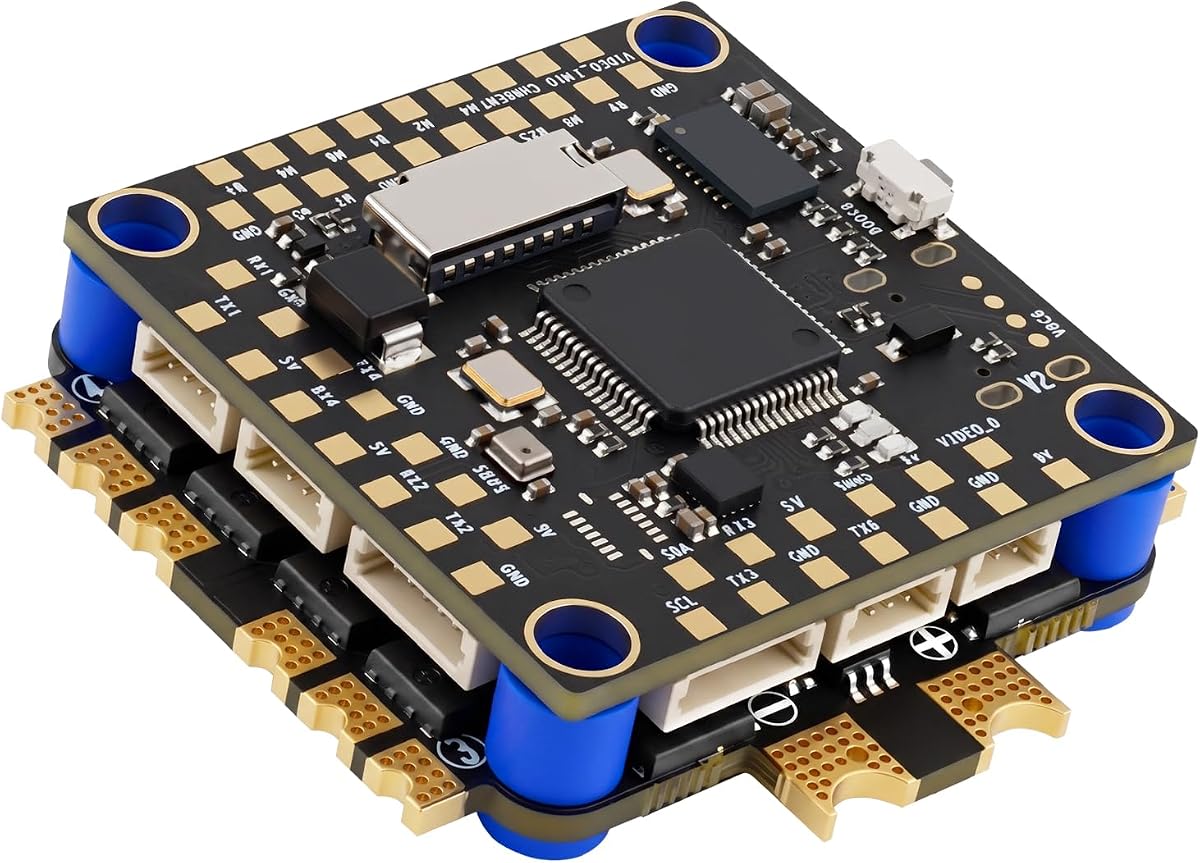
The H743 Flight Controller with 60A 32 bit ESC offers a powerful combination for high performance drone builds. It features an STM32H743 processor and dual IMUs providing superior motor control and flight stability. The stack supports 2-8S LiPo batteries making it suitable for a wide range of power requirements.
We may earn a commission when you buy through this link, at no additional cost to you.
Its versatility extends to firmware support including Betaflight INAV PX4 and Ardupilot ensuring ease of setup for various applications. The ESC delivers continuous 60A per channel with burst currents over 80A ensuring optimal power and responsiveness. Comprehensive connectivity options like UART ports and CAN buses allow for extensive expansion.
The stack is designed with a compact lightweight form factor fitting a wide variety of drone frames efficiently. It includes 7 UART ports and 10 PWM outputs offering vast potential for adding sensors telemetry or peripherals. This makes it a flexible solution for complex builds requiring advanced customization.
We recommend this stack for users who need high current capacity and broad firmware support. It is particularly well-suited for FPV and racing drones but also works for VTOL builds with robust motor configurations. The combination of performance and expandability makes it a strong contender in the market.
The 60A ESC handles demanding motor loads with continuous and burst current support.
Multiple UART ports enable easy integration of additional peripherals and sensors.
We may earn a commission when you buy through this link, at no additional cost to you.
The H743 Flight Controller with 50A 8 bit ESC provides ultra-responsive motor control for agile flight performance. It features an STM32H743 processor with dual IMUs and supports firmware like Betaflight Ardupilot PX4 and INAV. The stack is designed for FPV and racing drones but adapts well to hybrid VTOL needs.
We may earn a commission when you buy through this link, at no additional cost to you.
Its ESC supports 2S-6S lithium batteries delivering 50A continuous current per channel for consistent power. High-frequency PWM DSHOT and ONESHOT protocols ensure precise throttle response during complex maneuvers. The lightweight design simplifies installation and enhances assembly efficiency for space-constrained frames.
Connectivity options include 7 UART ports and 10 PWM outputs allowing for sensor and peripheral integration. The compact design ensures compatibility with a wide range of drone frames making it a flexible solution. This stack balances performance and weight effectively for high agility applications.
We recommend this stack for builders prioritizing weight savings and fast throttle response. It is suitable for smaller builds that do not require the higher current of the 60A version. The broad firmware compatibility ensures it can be customized to meet specific flight characteristics.
High-frequency protocols ensure accurate control for fast and dynamic flight.
Compact design allows for easier installation in smaller drone frames.
We may earn a commission when you buy through this link, at no additional cost to you.
The Pixhawk 6C Flight Controller delivers high performance with a 32-bit STM32H743 processor running up to 480MHz. It features dual redundant IMUs from Bosch and InvenSense with temperature control for reliable operation in varying conditions. Pre-installed PX4 Autopilot ensures it is ready for complex autonomous vehicle algorithms.
We may earn a commission when you buy through this link, at no additional cost to you.
Its advanced vibration isolation system effectively filters out high-frequency noise guaranteeing precise readings and better flight performance. The controller supports ArduPilot and features a hardware-switchable PWM signal mode for wide peripheral hardware support. It is designed for academic research and commercial autonomous vehicle applications.
The unit offers a cost-effective design with a low-profile form factor suitable for various use cases. Available in plastic or aluminum cases it balances weight and durability for different project needs. Connectivity is flexible allowing users to adapt the system to specific sensor configurations.
We recommend this controller for advanced users requiring reliability and computational power for autonomous tasks. It is an excellent choice for commercial and research drones where vibration isolation is critical. The pre-installed software reduces setup time and ensures a reliable starting point for development.
Dual IMUs provide critical backup ensuring consistent sensor data even if one unit fails.
Integrated isolation filters noise for accurate sensor readings in high vibration environments.
We may earn a commission when you buy through this link, at no additional cost to you.
The AERO SELFIE F405NC Flight Controller is a high-performance stack offering dual IMUs and broad firmware compatibility. It features an STM32F405 processor with BMI42688 IMUs ensuring reliable flight dynamics. The stack supports Betaflight INAV and Ardupilot making it easy to configure for different flight modes.
We may earn a commission when you buy through this link, at no additional cost to you.
The ESC supports 2S-6S LiPo batteries providing continuous 60A per channel with burst currents over 80A. This ensures optimal power and responsiveness for high-performance drones. Its compact design fits a wide variety of frames while minimizing added weight for efficient space management.
Connectivity includes 6 UART ports 10 PWM outputs and OSD support for expansion. The lightweight construction allows for easy integration into diverse builds. This stack offers a reliable combination for users needing robust performance without a high price tag.
We recommend this controller for budget-conscious builders who need reliable dual IMU support. It is ideal for FPV and racing applications where performance and price are key considerations. The compatibility with major firmware ensures long-term support and ease of use.
Dual IMUs and broad firmware support provide high-end features at an affordable price.
Multiple UART ports allow for versatile sensor and peripheral integration.
We may earn a commission when you buy through this link, at no additional cost to you.
The AERO SELFIE H743 Flight Controller offers high performance processing with an STM32H743 processor and dual IMUs. It supports Betaflight PX4 INAV and Ardupilot ensuring quick configuration for various flight types. The ESC supports 2S-6S LiPo batteries delivering continuous 60A per channel for reliable motor control.
We may earn a commission when you buy through this link, at no additional cost to you.
Its connectivity options include 7 UART ports 10 PWM outputs CAN I2C and OSD support. This allows for vast expansion potential for additional sensors telemetry or peripherals like GPS. The lightweight compact design fits a wide variety of drone frames ensuring easy installation.
While the rating is lower than others it offers strong specifications for users seeking versatility. The dual IMU and compass support ensure stable flight dynamics across different environments. It is a flexible solution for complex builds requiring robust hardware capabilities.
We recommend this controller for users who prioritize raw processing power and expansion options. It is suitable for those building custom FPV or racing drones needing broad firmware support. The compact design makes it a practical choice for integration into standard frames.
The H743 processor provides the power needed for advanced flight calculations.
Multiple ports allow for adding complex sensor suites and telemetry systems.
We may earn a commission when you buy through this link, at no additional cost to you.
Choosing the right flight controller for hybrid VTOL and VTOL drones requires considering several technical factors to ensure stability and performance. This guide outlines key elements to evaluate when selecting a controller for your specific project needs.
Ensure the controller supports open source firmware like PX4 or Ardupilot which are essential for VTOL transitions. These systems offer robust algorithms that manage the complex shift between hover and forward flight. Without the right firmware your drone may struggle with stability during critical transition phases.
Choose a controller with community support to access updates and troubleshooting resources.
Modern VTOL builds require significant computational power for processing sensor data and controlling motors simultaneously. Look for controllers with processors like STM32F4 or STM32H7 which handle high load tasks efficiently. Faster processors reduce latency and improve response times during dynamic flight maneuvers.
Prioritize models with at least an F405 core for reliable performance in complex builds.
Redundant IMUs and barometers provide backup data in case of sensor failure or interference. This is vital for VTOL drones that operate in diverse environments where reliability is paramount. Controllers with dual IMUs ensure continuous stable flight even if one sensor encounters issues.
Select units with temperature controlled IMUs for consistent performance across varying conditions.
Ensure the controller has enough UART ports to connect GPS receivers telemetry modules and cameras. Flexibility in connectivity allows you to expand the drone with additional features over time. A controller with multiple outputs simplifies wiring and reduces congestion on the main board.
Verify the number of available ports matches your planned sensor and peripheral count.
Check that the flight controller and associated ESC support the voltage range of your battery setup. Some models are limited to lower voltages while others handle higher cell counts for extended power. Selecting the wrong voltage can lead to component failure or reduced flight efficiency.
Choose a controller compatible with your specific LiPo battery configuration for safety.
Vibration from motors can affect sensor readings leading to unstable flight in VTOL configurations. Integrated vibration isolation or rubber grommets help filter out high-frequency noise. This is particularly important for precise flight control and accurate navigation data.
Look for controllers designed with isolation systems to improve sensor accuracy.
Standard mounting patterns like 30x30mm ensure compatibility with various frames and accessories. A compact design helps minimize weight which is crucial for efficient flight performance. Ensure the physical size fits within your chosen frame without causing obstruction.
Verify the dimensions align with your frame mounting points for a secure fit.
Controllers with clear documentation and beginner friendly setup guides save time during assembly. User friendly software interfaces allow you to monitor parameters without complex coding. A straightforward configuration process is essential for maintaining a productive workflow.
Select models with quick start guides to simplify the initial installation phase.
Begin by connecting the flight controller to your ground station using the USB port and ensuring all sensors are properly installed. Use the accompanying software to run a sensor calibration routine which aligns the gyroscope and accelerometer for accurate data. This step is critical to ensure the drone responds correctly during takeoff and flight.
Regularly inspect the mounting points and wiring for signs of wear or damage caused by vibration or environmental factors. Clean the controller with compressed air to remove dust that could interfere with internal components. Proper maintenance extends the lifespan of the unit and prevents unexpected failures during operation.
Update the firmware periodically to benefit from the latest features and stability improvements. Always back up your configuration settings before applying any new updates to avoid losing your custom preferences. Following these care practices ensures your drone remains reliable and safe for continuous use.
Hybrid VTOL controllers manage complex transitions between helicopter mode and airplane mode using sophisticated algorithms. Fixed VTOL systems often rely on simpler configurations where vertical and forward flight are distinct phases. Hybrid controllers usually require higher processing power to handle the simultaneous control of rotors and fixed wings.
While Betaflight is primarily for multirotor FPV it does have limited support for VTOL in specific versions. For serious VTOL projects Ardupilot or PX4 are recommended because they offer dedicated VTOL modes. These firmware types provide more reliable control over the transition from hover to forward flight.
A dual IMU controller significantly improves reliability by providing redundant data for critical flight parameters. This is especially important in VTOL builds where sensor failure can lead to catastrophic loss of control. While single IMU units work redundant systems are preferred for professional and commercial applications.
Use rubber grommets or specialized vibration isolation mounts to reduce mechanical noise reaching the sensors. Ensure the motors and props are balanced properly to minimize unnecessary oscillations. Many high-end controllers come with built-in isolation features that simplify this process.
Both PX4 and Ardupilot are capable of VTOL operations but they have different strengths depending on the project. PX4 is known for modularity and modern architecture making it ideal for custom research projects. Ardupilot offers a vast community and extensive documentation which helps beginners get started faster.
Check the maximum input voltage supported by the controller and ESC stack before selecting a battery. Most modern units support 6S or higher which provides longer flight times. Ensure your battery voltage stays within the specified limits to prevent damage to the electronic components.
We reviewed ten top controllers ranging from budget friendly stacks to high end autopilot systems. The Pixhawk 2.4.8 and 6C models offer reliable open source solutions while the H743 stacks provide raw performance. Choosing the right unit depends on your specific build requirements and experience level.
Prioritize sensors redundancy and firmware compatibility when making your final selection to ensure safety. Ensure that the controller supports the voltage and current needs of your motors and battery system. Taking the time to research these details will result in a smoother flight experience.
Prices and availability change frequently so verify the latest details on Amazon before making a purchase. We hope this guide helps you find the perfect flight controller for your next hybrid VTOL project.