
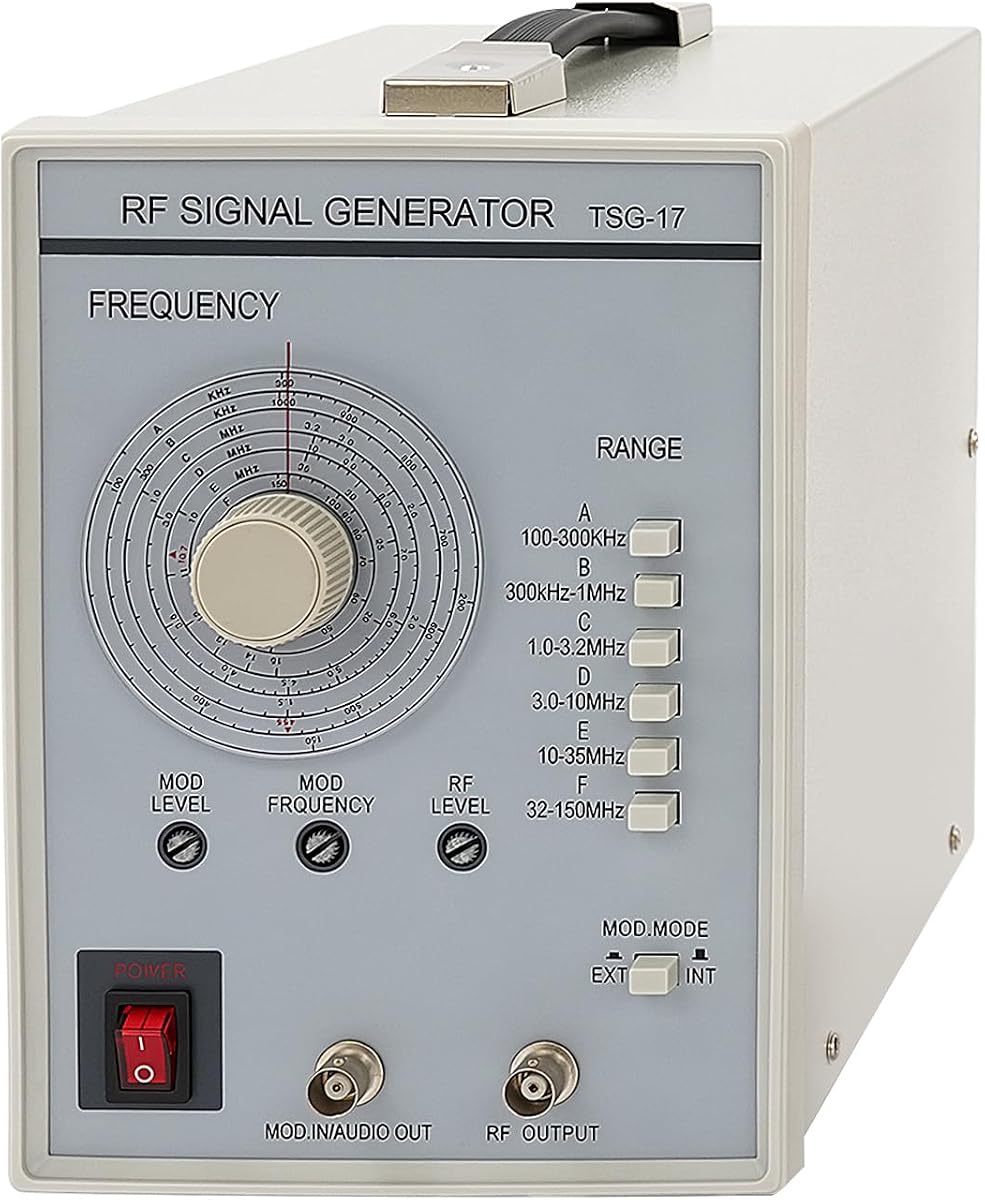
6-Band Signal Generator
100KHz to 150MHz range
Low phase noise signal
Simple knob operation
This guide compares the top Amfm Signal Generator models for 2026, evaluating performance, modulation features, and value for engineers and hobbyists alike.
Selecting the right Amfm Signal Generator is crucial for electronics testing, radio maintenance, and educational purposes. A good unit provides precise frequency control, stable output, and versatile modulation options to meet diverse technical needs effectively.
We evaluated ten leading models based on frequency range, modulation capabilities, build quality, and user feedback. Each product was analyzed for its ability to deliver reliable signals across various applications, ensuring you find a tool that matches your specific requirements.
Our detailed reviews highlight the strengths and weaknesses of each generator, helping you make an informed decision. Note that availability and pricing may vary over time, so check the latest offers before purchasing your preferred model for your lab or fieldwork.

5.0Editor score

5.0Editor score
The following table offers a side-by-side comparison of all ten Amfm Signal Generators, highlighting key specifications such as frequency range, modulation types, and special features to help you quickly identify the best fit for your needs.




The UNI-T UTG962E stands out as a top contender in the Amfm Signal Generator category. With a perfect rating of 5.0, it delivers high-performance capabilities in a compact form factor. This handheld generator is ideal for engineers and enthusiasts who need reliable signal generation on the go.
We may earn a commission when you buy through this link, at no additional cost to you.
Its key strengths include a 60 MHz frequency range and dual-channel output, allowing for complex testing scenarios. The inclusion of AM, FM, and PM modulation ensures versatility across various electronic applications. The device supports arbitrary waveforms and offers scan functionality for comprehensive analysis.
While it excels in performance, the price point is higher than entry-level models. However, the cost is justified by the build quality and feature set. The limited deep memory might be a constraint for very specialized waveform storage needs but is sufficient for most standard tasks.
This unit is highly recommended for professionals requiring precision and portability. It balances advanced features with ease of use, making it a valuable addition to any lab or field toolkit. Users will appreciate the included accessories and intuitive design.
The 200 MS/s sample rate ensures accurate waveform reproduction for detailed testing requirements.
Support for AM, FM, and PM modulation allows users to test a wide range of communication systems.
We may earn a commission when you buy through this link, at no additional cost to you.
The OWON DGE2035 is designed for precise and stable signal generation in laboratory settings. It boasts a 14-bit resolution and a 125MSa/s sampling rate, ensuring high-quality output. The 3.6-inch TFT LCD provides a clear view of real-time waveform status and settings.
We may earn a commission when you buy through this link, at no additional cost to you.
Its dual-channel support and extensive arbitrary waveform library make it suitable for research and educational training. The PC control capability enhances its utility for automated testing environments. Users can store non-volatile digital waveforms for repeated use.
While the frequency output is capped at 35 MHz, this is sufficient for many applications. The user-friendly design is offset by a learning curve for new users. However, the advanced features justify the complexity for those needing precise control.
This generator is perfect for research labs and electronics engineers. It balances performance with portability, making it easy to transport between workspaces. The combination of visual clarity and programmable options adds significant value to any technical setup.
The 14-bit resolution ensures minimal distortion in generated signals for accurate measurements.
USB connectivity allows for remote control and integration into larger automated test systems.
We may earn a commission when you buy through this link, at no additional cost to you.
The 6-Band Signal Generator offers exceptional value for those needing a reliable RF signal source. It covers a wide frequency range from 100KHz to 150MHz across six bands. The low phase noise characteristic ensures signal purity, crucial for testing environments with high quality requirements.
We may earn a commission when you buy through this link, at no additional cost to you.
Its simple operation and assembly-free design make it accessible for quick setup. The sturdy metal construction ensures durability and resistance to corrosion. Users can rely on it for routine electronic equipment maintenance and lab tasks without significant investment.
While it lacks advanced digital displays, the clear markings and knobs facilitate easy use. The limited modulation options are sufficient for basic AM and FM needs. This trade-off keeps the device affordable and straightforward for practical applications.
Ideal for hobbyists and technicians needing a dependable tool for general use. It prioritizes functionality and durability over complex features. This makes it a practical choice for maintaining radio equipment and other electronic devices in various settings.
High-class metal and plastic spraying ensure long service life and impact resistance.
Low phase noise reduces interference, ensuring accurate testing results for sensitive equipment.
We may earn a commission when you buy through this link, at no additional cost to you.
The Upgraded RF Signal Generator supports a broad spectrum from 35MHz to 4400MHz, covering many wireless applications. It features both single frequency and sweep modes for greater flexibility. The power-off memory saves parameters for continuous work after rebooting.
We may earn a commission when you buy through this link, at no additional cost to you.
Designed for portability, it can be powered by mobile chargers or USB connections. This makes it convenient for field work and remote testing scenarios. The simple screen display helps users set frequencies quickly without complex menus.
While the waveform is primarily sine with some noise, it serves basic needs well. Performance can vary compared to higher-end models, but the frequency coverage is impressive. Users should manage expectations regarding precision for high-precision tasks.
This tool is suitable for general RF testing and maintenance. It offers an affordable entry point for those needing high-frequency capabilities. Its flexibility in power supply adds to its utility for mobile technicians and hobbyists.
Coverage up to 4400MHz supports testing of modern wireless and communication devices.
Ability to use mobile power banks allows for uninterrupted operation in remote locations.
We may earn a commission when you buy through this link, at no additional cost to you.
The TSG-17 is a traditional high-frequency signal generator designed for commercial and household use. It covers a range from 100kHz to 150MHz with three harmonics. The output wave form is sine and amplitude modulation, suitable for basic AM radio testing.
We may earn a commission when you buy through this link, at no additional cost to you.
It allows external modulation signals from 50Hz to 20 KHz, adding some flexibility. Control over output voltage ranges from 1mV to 100m for precise adjustments. This makes it adaptable for specific maintenance tasks requiring standard RF outputs.
However, lower user ratings suggest potential reliability issues compared to modern alternatives. The features are basic and lack digital enhancements. Users may find it adequate for very specific legacy systems but limited for advanced applications.
This generator might be considered if compatibility with older equipment is the priority. It provides standard RF and AM capabilities without complex interfaces. For most general uses, newer models offer better value and reliability.
Produces standard sine and amplitude modulation waves for classic radio testing needs.
External modulation input allows for adding specific signals to the carrier wave.
We may earn a commission when you buy through this link, at no additional cost to you.
This generator focuses on industrial process control with 4-20mA current and 0-12V voltage outputs. It includes PWM functionality for adjustable frequency and duty cycle. The built-in 3.7V lithium battery allows for portable use without external power sources.
We may earn a commission when you buy through this link, at no additional cost to you.
Safety features like short circuit and reverse connection protection make it reliable for field testing. The device stores output values when powered off, ensuring consistent setup. This is ideal for technicians calibrating sensors and controllers in industrial settings.
While frequency capabilities are limited, the analog signal generation is accurate. The battery life varies by load, requiring planning for extended use. The compact design and protection features add significant value for maintenance professionals.
Recommended for professionals working with PLCs and industrial sensors. It provides a practical solution for simulating process signals safely. The rechargeable nature supports mobility, making it convenient for on-site calibration tasks.
Outputs standard 4-20mA and 0-10V signals used in process control loops and sensors.
Built-in rechargeable battery enables use in remote locations without access to mains power.
We may earn a commission when you buy through this link, at no additional cost to you.
The Riiai generator offers precise voltage and current simulation for debugging electronic circuits. With a 4-digit display, users can view settings clearly in different modes. The precision of 0.01V and 0.01mA ensures accurate signal generation for sensitive components.
We may earn a commission when you buy through this link, at no additional cost to you.
It supports dual power supply modes, allowing flexibility for indoor or outdoor use. Safety features include short circuit and reverse connection protection, enhancing device longevity. The compact size makes it easy to carry in a technician's toolkit.
While the battery capacity is modest, the charging via micro USB is convenient. The focus on accuracy and safety makes it reliable for industrial panel debugging. Users will appreciate the straightforward operation and robust build quality.
This device is ideal for PLC panel debugging and device testing. It provides the necessary precision for calibration tasks. The combination of safety and portability makes it a strong choice for field service engineers.
The 4-digit display provides clear readouts of voltage and current settings for accuracy.
Built-in protections against short circuits ensure safe testing with connected equipment.
We may earn a commission when you buy through this link, at no additional cost to you.
The Riiai SG003A supports various signal types including current, voltage, and pulse signals. Its 2.4-inch TFT color screen provides clear visibility for real-time curves. The 3000mAh battery supports up to 26 hours of working time for extended field use.
We may earn a commission when you buy through this link, at no additional cost to you.
Programmable output modes allow for automatic changes, monotonic rise, or cycles. This automates testing processes and increases efficiency for industrial technicians. The device is well-suited for PLC testing and valve adjustments.
While the feature set is rich, it may be complex for basic users. However, the versatility and long battery life justify the learning curve. It bridges the gap between simple simulators and professional instruments.
Highly recommended for professionals needing advanced analog simulation capabilities. It offers a comprehensive tool for system maintenance and calibration. The auto functions and large battery make it practical for demanding environments.
A 3000mAh battery ensures long operational periods during extended field maintenance.
Support for current, voltage, and pulse signals covers a wide range of testing needs.
We may earn a commission when you buy through this link, at no additional cost to you.
This DROK generator is a multifunctional module capable of producing ampere and voltage signals. It uses a precise potentiometer for simple and handy adjustment. The device is ideal for value adjusting, panel testing, and general analog signal needs.
We may earn a commission when you buy through this link, at no additional cost to you.
Its compact design allows it to fit into tight spaces for industrial testing. Users can generate 0/4-20mA current and 0-10V voltage with minimal effort. This simplicity reduces the risk of operation errors in fast-paced environments.
The lack of digital readout requires external meters for precise verification. However, for general simulation tasks, the analog nature is sufficient. It remains a cost-effective solution for technicians needing quick signal generation.
Best suited for simple analog simulation tasks and basic calibration. It provides essential functionality without unnecessary complexity. The ease of use makes it a reliable companion for routine testing duties.
A multi-cycle potentiometer allows for intuitive control of signal output levels.
Small module form factor facilitates easy storage and transport to job sites.
We may earn a commission when you buy through this link, at no additional cost to you.
The SEESII Dual Channel 30MHz offers premium precision with independent dual-channel output. It features high frequency accuracy and low distortion for reliable test results. This 7-in-1 instrument integrates multiple tools, saving desktop space effectively.
We may earn a commission when you buy through this link, at no additional cost to you.
Arbitrary waveform output allows for custom signal simulation and circuit design testing. The 2.4-inch TFT LCD displays real-time waveforms clearly. Complete accessories ensure readiness for immediate use out of the box.
While the price is higher, the advanced capabilities justify the investment for engineers. It covers a wide range of application scenarios from research to maintenance. The precision and flexibility are unmatched in its price class.
This unit is recommended for engineering R&D and advanced lab environments. It provides professional-grade performance for detailed testing needs. The comprehensive feature set makes it a versatile asset for any technical setup.
Two equal-performance channels allow simultaneous or differential circuit testing with phase adjustment.
14-bit resolution and 266MSa/s sampling ensure low distortion for accurate measurements.
We may earn a commission when you buy through this link, at no additional cost to you.
Choosing the right generator requires understanding your specific testing needs and environment.
Ensure the generator covers the frequencies required for your specific devices. Radio equipment may need higher ranges while audio testing might only need lower ones.
Look for support of AM and FM modulation as standard. Advanced models may offer PM and FSK, which are crucial for complex communication testing scenarios.
Dual channel units allow for simultaneous testing of different signals. This is beneficial for differential circuit analysis but single channel may suffice for basic needs.
Higher resolution and accuracy ensure precise signal generation. Look for at least 12-bit resolution and stable frequency accuracy for professional applications.
If you work in the field, a handheld unit with battery power is essential. Benchtop models usually require mains power but offer more features.
A sturdy metal case ensures durability in lab or field environments. Resistance to drops and corrosion extends the lifespan of the device significantly.
Clear displays and logical controls reduce setup time. A user-friendly interface allows you to focus on testing rather than troubleshooting the generator.
USB connectivity allows for PC control and automated testing. This is valuable for integration into larger production or analysis systems.
Connect the output cables securely to your device under test to avoid signal loss. Ensure the ground connection is stable to prevent interference.
Set the frequency and amplitude carefully using the controls or menu. Verify settings with a multimeter or oscilloscope if precision is critical.
Store the device in a dry, cool place when not in use. Avoid dropping or exposing it to extreme temperatures to maintain accuracy.
An Amfm Signal Generator is used to produce radio frequency signals with amplitude or frequency modulation. It is essential for testing radios, audio equipment, and communication systems.
Dual channel generators are useful for testing differential circuits or comparing signals simultaneously. If you only test single signal paths, a single channel model might be sufficient.
Calibration often requires an external reference meter to adjust output levels. Follow the manufacturer's manual to access calibration modes or send it to a certified service center.
Yes, many hobbyists use these generators to test custom-built radios and antennas. Ensure the frequency range matches your project requirements.
Standard waveforms include sine, square, and triangle shapes. Arbitrary waveforms allow custom signal shapes for advanced simulation and testing scenarios.
High-end portable units can match benchtop accuracy but are more compact. Entry-level portables might have slightly less precision suitable for casual use.
Our top picks include the UNI-T UTG962E for overall performance and the SEESII Dual Channel for premium precision. The 6-Band Generator offers excellent value for budget-conscious buyers.
Prioritize frequency range and modulation options based on your specific testing needs. A generator that matches your technical requirements will provide the best return on investment.
Remember to check current availability and pricing before purchasing. Prices may fluctuate over time, so reviewing the latest offers ensures you get the best deal.