
1/2 Flow Hall Sensor
4.7Editor score
NPT thread connection
1 to 30 L/min flow range
Compact lightweight design
Arduino flow meters are essential components for makers monitoring fluid usage in projects like smart irrigation or water purification systems. Selecting the right sensor ensures accurate data collection and reliable operation over time without frequent calibration needs.
We evaluated ten popular models based on flow range, thread compatibility, and sensor reliability. Our analysis focused on real-world performance data and user feedback to identify the most consistent performers in various environmental conditions.
Each pick highlights key features and ideal use cases to help you match a sensor to your specific project requirements. Please note that availability and pricing may change frequently so check current listings before purchasing.
4.7Editor score

5.0Editor score

4.8Editor score
As an Amazon Associate we earn from qualifying purchases.
The following table offers a side by side comparison of all ten models evaluated in this guide. Review each specification carefully to determine which sensor best fits your Arduino project needs.


This DIGITEN model stands out as the top choice for Arduino projects requiring a broad measurement range. With a perfect rating and a flow capacity spanning 5 to 150 liters per minute it handles both low and high volume tasks with ease.
We may earn a commission when you buy through this link, at no additional cost to you.
The G1.5 inch BSPT male thread ensures a secure fit in larger plumbing systems while the Hall effect sensor provides consistent pulse outputs for accurate counting. Users appreciate that all materials meet ROHS standards making it safe for drinking water applications.
While the larger thread size might require an adapter for small diameter hoses the pressure resistance up to 1.75 Mpa ensures durability under stress. The heat and cold resistance also mean it can function reliably in varied environmental conditions without degradation.
If your project demands high capacity monitoring or integration with reverse osmosis filters this sensor delivers the performance needed. Its solid construction and wide operating voltage range make it a long lasting addition to any serious water management system.
The 5 to 150 L/min flow range allows this sensor to be used in everything from small coffee machines to industrial cooling loops without requiring multiple units.
All materials align with ROHS testing standards ensuring that the sensor is safe for contact with drinking water in purifiers and beverage machines.
We may earn a commission when you buy through this link, at no additional cost to you.
Affordability defines this sensor making it an ideal entry point for makers experimenting with Arduino based water monitoring. It offers a solid 1 to 30 liter per minute range that covers most household and hobbyist applications effectively.
We may earn a commission when you buy through this link, at no additional cost to you.
The NPT thread provides a standard connection for many pipe systems and the integrated magnetic hall effect sensor keeps the electrical components sealed away from water. This design helps maintain dry electronics which is crucial for longevity in wet environments.
One critical installation detail is ensuring flow direction matches the product marking since incorrect orientation results in no signal output. While this adds a step during setup it is a common trade off for the low cost and compact form factor provided.
For budget conscious projects like smart card equipment or beverage machines this sensor delivers reliable pulse counting without breaking the bank. Its nimble outline and easy install features make it a practical choice for temporary or permanent setups alike.
The small and lightweight outline allows for installation in tight spaces where larger sensors would not fit comfortably without complex rerouting of pipes.
The NPT thread ensures compatibility with many existing plumbing fittings which simplifies integration into systems that already use this standard connection type.
We may earn a commission when you buy through this link, at no additional cost to you.
This model excels by including a generous 1.2 meter cable which offers significant flexibility when positioning your Arduino away from the water line. The high rating reflects user satisfaction with its build quality and consistent performance over time.
We may earn a commission when you buy through this link, at no additional cost to you.
The SM2.54 3P wire connector simplifies integration with breadboards and PCBs allowing for quick connections without soldering. This convenience saves time during prototyping and ensures secure electrical contact that reduces noise in the signal output.
While the cable length is a major benefit it may require management to prevent tangling or strain during installation. However the trade off is worth it for projects where the controller needs to be housed in a dry cabinet or enclosure.
Ideal for reverse osmosis filters and water purifiers this sensor combines safety standards with durable materials that withstand heat and pressure. If you need a reliable and easy to install solution this premium pick is a strong candidate.
The 1.2 meter cable provides ample slack to route the sensor output to a controller box without stressing the wiring or connection points.
The SM2.54 3P connector matches standard hobbyist wiring kits making it straightforward to plug into microcontroller interfaces for immediate testing and data logging.
We may earn a commission when you buy through this link, at no additional cost to you.
This sensor focuses on providing a safe and reliable option for applications involving food and beverages. The food grade plastic construction ensures that no harmful materials leach into the water flow during monitoring which is critical for health related projects.
We may earn a commission when you buy through this link, at no additional cost to you.
It supports a broad working voltage range of 5 to 24 volts which gives flexibility in power supply choices for different microcontroller setups. The inclusion of a specific flow formula helps users calculate the actual rate more accurately from the raw pulse signal.
The standard G1/2 inch BSPT male thread connects easily to common piping systems and the pressure limit of 1.75 Mpa handles typical domestic water pressures well. While the rating is slightly lower than top picks it still offers decent performance for the price.
Choose this model if your primary concern is material safety for potable water and you need a simple no fuss sensor for a coffee machine or beverage dispenser. Its compliance with ROHS standards adds an extra layer of assurance for environmental and health safety.
All raw materials conform to ROHS test standards and are rated as food grade ensuring safe contact with drinking water in various household machines.
A working voltage range of 5 to 24 volts allows the sensor to work with both 5V Arduino logic and 24V industrial power supplies without extra circuitry.
We may earn a commission when you buy through this link, at no additional cost to you.
The transparent valve body is the standout feature here allowing users to visually inspect water flow and rotor conditions without disassembly. This is particularly useful for debugging flow issues or verifying water presence in a pipeline during testing phases.
We may earn a commission when you buy through this link, at no additional cost to you.
Sold as a pack of two these sensors provide value for projects needing multiple points of measurement or a spare unit for backup. The internal impeller uses stainless steel beads for wear resistance which helps extend the lifespan under frequent usage.
While the rating is lower than other options the unique visual aspect and dual pack offering make it a good choice for experimental setups. Ensure the transparent material remains clean as scaling or residue could obscure the view over time.
For automatic water dispensers or water heaters where seeing the flow helps with troubleshooting this model offers a practical advantage. Just be mindful of the voltage range and pressure limits to ensure stable operation within safe boundaries.
The transparent valve body facilitates direct observation of the water flow and rotor conditions helping users spot clogs or air bubbles quickly.
Getting two sensors in one package allows for redundant measurements or provides a replacement unit if one fails during a long term project.
We may earn a commission when you buy through this link, at no additional cost to you.
This sensor is specifically designed for low flow applications where other larger sensors might struggle to detect movement accurately. It connects directly to hosepipes with an inner diameter of 5 to 7 mm making it ideal for garden or drip irrigation monitoring.
We may earn a commission when you buy through this link, at no additional cost to you.
The G1/4 inch connector simplifies setup with flexible tubing which is common in many hobbyist projects. With a flow range of 0.3 to 6 liters per minute it captures small changes that could be missed by devices built for higher throughput.
Safety is maintained with food grade plastic materials and ROHS compliance ensuring it is suitable for drinking water systems even at low rates. The pressure tolerance of up to 0.8 Mpa fits well with standard domestic hose pressures without risk of rupture.
Choose this model if your project involves drip irrigation or precise low volume water usage tracking. Its compact design and specialized low range make it a perfect tool for applications where accuracy at minimal flow is the primary goal.
The 0.3 to 6 L/min range ensures that even very slow water movement can be detected and counted accurately by the hall effect sensor.
Designed to connect to hosepipes with an inner diameter of 5 to 7 mm this sensor integrates seamlessly with standard garden tubing systems.
We may earn a commission when you buy through this link, at no additional cost to you.
This model is highlighted by a perfect user rating indicating high satisfaction with its performance and reliability in water heating systems. The magnetic rotor rotates based on flow rate changes which allows for precise detection of water movement for the inlet.
We may earn a commission when you buy through this link, at no additional cost to you.
The Hall sensor outputs a corresponding pulse signal that feeds back to the controller enabling regulation of water flow. This direct feedback loop is crucial for maintaining consistent temperature or dispensing rates in appliances like water heaters and dispensers.
Its standard G1/2 interface ensures compatibility with many existing plumbing setups without requiring special adapters. While the design is straightforward the focus on reliable signal generation makes it a strong choice for applications where timing and control are critical.
If you are building or modifying a water heater project this sensor provides the necessary feedback to automate the process effectively. The perfect rating suggests that users find it robust and accurate for monitoring influent flow rates under normal operating conditions.
The magnetic rotor assembly ensures that the Hall sensor produces a consistent pulse signal for accurate flow regulation by the controller.
Designed specifically to detect influent flow rate at the water inlet this sensor is optimized for performance in water heating applications.
We may earn a commission when you buy through this link, at no additional cost to you.
This sensor is designed for situations where space is constrained and a smaller connection size is required. The G3/8 connection fits well into compact plumbing runs and the low flow range of 0.3 to 10 liters per minute suits smaller household appliances.
We may earn a commission when you buy through this link, at no additional cost to you.
Its waterproof and heat resistant properties ensure that it can handle temperature fluctuations without failure. The square wave output provides a clean signal that is easy for microcontrollers to read without excessive filtering or noise reduction.
Operating at 3.5 to 12 volts makes it compatible with a variety of power sources including battery powered setups for portable projects. The small size and easy install design mean you can get it up and running quickly without specialized tools.
If you need a sensor for reverse osmosis filters or drinking fountains where space is at a premium this model is a practical choice. It balances size and performance well to deliver accurate flow data in tight installation environments.
The small size and easy install design make it suitable for tight spaces where larger sensors would not fit without modifying the plumbing.
A square wave pulse signal ensures that the data sent to the Arduino is clean and easy to process for accurate flow measurement.
We may earn a commission when you buy through this link, at no additional cost to you.
This model is recognized for its strong signal output which helps in ensuring that the pulse can be detected reliably even over longer wires. The high amplitude of at least 4.6 volts provides a clear distinction between on and off states for the controller.
We may earn a commission when you buy through this link, at no additional cost to you.
With a low amplitude of 0.5 volts or less the sensor maintains a good signal to noise ratio which is critical for accurate counting. The electric strength of 1250 volts per minute indicates it can withstand voltage spikes without damage.
Its application scope covers water testing and cooling systems making it versatile for different types of fluid monitoring tasks. The 1 to 30 liter per minute range is typical for standard home use and aligns well with most Arduino project needs.
If signal reliability is your primary concern this sensor offers the electrical characteristics needed for robust performance. It is a solid choice for water vending machines and credit card systems where consistent detection is key to operation.
A high amplitude of 4.6 volts or more ensures a clear signal that reduces the risk of missed pulses in noisy environments.
An electric strength of 1250 volts per minute provides a safety margin against voltage spikes that could otherwise damage the sensor internals.
We may earn a commission when you buy through this link, at no additional cost to you.
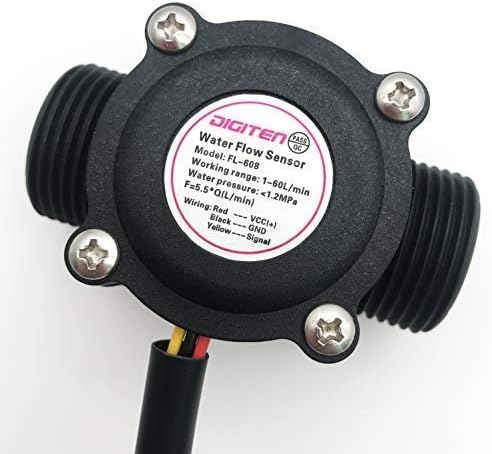
This sensor is built for larger flow rates with a capacity of up to 60 liters per minute which suits industrial or heavy duty residential applications. The G3/4 inch BSPT male thread ensures a secure fit for larger pipes often found in main water lines.
We may earn a commission when you buy through this link, at no additional cost to you.
The 1.2 meter cable provides flexibility to place the controller away from the sensor which is helpful in systems where the plumbing is remote from the logic board. It maintains heat and cold resistance so it can operate in varied temperature conditions.
The square wave output is consistent with other models making it easy to integrate into existing code. While the rating is lower it still offers a unique capability for higher flow ranges that other models in this list do not cover.
If you need to monitor a larger volume of water and have space for a bigger connection this is a viable option. Just ensure you are comfortable with the voltage range and pressure limits to keep the system running safely.
The flow range of 1 to 60 liters per minute allows this sensor to handle larger water volumes common in main supply lines or industrial loops.
The G3/4 inch BSPT male thread connects to larger pipes ensuring a secure fit for high volume plumbing systems.
We may earn a commission when you buy through this link, at no additional cost to you.
Choosing the right Arduino flow meter depends on several technical factors that impact compatibility and accuracy. We review the most important specs to help you make a confident decision for your project.
The flow range determines the minimum and maximum water volume the sensor can measure accurately. If your project involves low flow drip irrigation you need a model that detects under one liter per minute. For main line monitoring a higher capacity up to 60 liters per minute may be required to avoid saturation.
Always match the sensor range to your expected usage to ensure precise data collection and avoid hardware stress.
Connection type is critical for physical integration. Common sizes include G1/2 G3/8 G1/4 and G1.5 inches. If your pipes use NPT threads you may need an adapter or a specific sensor version. Verify the gender of the thread to ensure a leak proof fit without excessive tightening.
Select a thread size that matches your existing plumbing to simplify installation and reduce the need for extra fittings.
Most hall effect flow sensors operate between 5 and 24 volts DC. Ensure your Arduino or power source matches this requirement. Some models support a wider range which gives more flexibility for battery powered or variable supply systems. Check the logic voltage compatibility with your microcontroller pins.
A compatible voltage range prevents damage and ensures the output signal stays within the safe reading limits of your controller.
A built in cable allows for flexible placement of the sensor away from the main controller. This is useful when the water line runs through a wall or cabinet. If the sensor has short leads consider the need for extension wiring. Check the connector type for ease of plugging into breadboards or PCBs.
Longer cables and standard connectors simplify wiring and keep electronics dry and protected in remote locations.
If the sensor will be in contact with drinking water ensure materials are food grade and safe for potable use. Look for ROHS compliance and certifications that indicate non toxic materials. This is vital for systems like reverse osmosis filters or beverage dispensers where health safety is a priority.
Choose sensors explicitly marked as safe for potable water to avoid contamination risks in your water supply.
Water pressure and temperature affect sensor longevity. Most models handle up to 1.75 Mpa but low flow hose versions may be limited to 0.8 Mpa. Heat and cold resistance ensure the sensor functions in varying climate conditions. Exceeding these limits can lead to mechanical failure or inaccurate readings.
Verify the pressure and temperature ratings match your system conditions to prevent leaks and ensure reliable operation.
Hall effect sensors typically output a square wave pulse. This digital signal is easy to count with microcontrollers. Some models provide higher amplitude signals which improve noise immunity. Ensure the output matches the input requirements of your specific Arduino board or signal conditioning circuit.
A clean square wave output with high amplitude makes it easier to count pulses accurately in noisy electrical environments.
Most flow sensors are directional and require water to flow in a specific direction. Installing them backward will result in no signal output. Check the arrow on the body to align with your pipe flow. Proper orientation ensures that the rotor spins correctly to generate pulses.
Align the sensor arrow with the direction of water flow to ensure it generates the necessary pulses for accurate counting.
Install the sensor inline with your water pipe ensuring the flow direction arrow points with the water stream. Use thread seal tape if needed to prevent leaks at the connection point. Secure the wiring to prevent strain on the sensor body or connector.
Connect the pulse output pin to a digital interrupt pin on your Arduino board. Configure your code to count pulses over a set time interval. Calculate flow rate using the sensor specific K factor provided in the documentation to get accurate volume data.
Regularly inspect the sensor for debris or scaling that might block the rotor. If the readings become inconsistent clean the inlet and rotor chamber gently with water. Avoid harsh chemicals that might degrade the plastic materials or seals.
Connect the sensor power pins to a 5V supply and ground. Attach the signal output to a digital interrupt pin on the Arduino. Use an external pull-up resistor if required and write code to count pulses per second to calculate flow rate.
With proper use and clean water flow most hall effect sensors last several years. Regular cleaning of the rotor and avoiding high pressure spikes can extend the lifespan significantly. Debris is the most common cause of wear over time.
Most models are designed for water and are not compatible with oils or corrosive liquids. Check the material compatibility before using with other fluids. Using incompatible liquids can damage the sensor or lead to inaccurate readings.
Check the flow direction arrow on the body and ensure water is moving in the correct direction. Verify that power connections are secure and that the output wire is properly connected to the interrupt pin. Also check for debris inside the rotor chamber.
Most factory calibrated sensors do not need user calibration but you can verify accuracy using a known volume. Measure the output pulses over a minute against a stopwatch and compare to the spec. Adjust your code multiplier if there is a consistent error.
The sensor body and electronics are sealed to prevent water damage during normal operation. However the electrical connector is not fully waterproof and should be protected from direct submersion. Use heat shrink tubing or a junction box for added safety.
We reviewed ten top flow meters ranging from compact low flow models to large capacity units for heavy duty use. The DIGITEN G1.5 model leads as the best overall due to its wide range and solid build quality. The 1/2 Flow Hall Sensor offers an excellent budget option for most hobbyists.
When selecting a sensor prioritize flow range and thread size to ensure it fits your project without complex adapters. Consider whether you need a built-in cable for flexible placement or if standard short leads are sufficient for your layout. Verify that the materials are safe for your fluid type.
Remember to check current availability and prices before purchasing since these details can change frequently. With the right sensor you can build reliable water monitoring systems that track usage efficiently and provide valuable data for automation projects.