
HiLetgo 3pcs ESP8266 ESP-01 Serial WiFi Wireless Transceiver Wireless Module Development Board LWIP AP+STA Compatible with Arduino
4.2Editor score
Supports AP STA and combined modes
Compact size for small projects
Low cost per unit
This guide compares the top ten Arduino WiFi modules for IoT projects, evaluating connectivity, compatibility, and performance for makers and engineers in 2026.
Selecting the right Arduino WiFi module is essential for building connected devices that communicate reliably over networks. Whether you need simple web control or complex data streaming, the right board ensures stability and ease of use.
We compared ten popular WiFi solutions based on connectivity options, processing power, and ease of integration with the Arduino IDE. This list covers everything from compact transceivers to full-featured boards with Bluetooth and USB support.
Each pick highlights key specifications, pros, and cons to help you match hardware to your project needs. Prices fluctuate frequently so always verify current listings before purchasing components for your build.
4.2Editor score

4.7Editor score

4.7Editor score
The following table provides a side-by-side overview of the ten selected WiFi modules focusing on core specifications to help you quickly identify the right fit for your Arduino projects.



The Arduino UNO R4 WiFi stands out as the top choice for advanced projects. It rates 4.7 stars and combines a Renesas RA4M1 with an ESP32-S3 for dual-core capabilities.
We may earn a commission when you buy through this link, at no additional cost to you.
Its standout quality is the built-in 12×8 LED Matrix which allows immediate visual feedback without extra screens. You get robust Wi-Fi and Bluetooth 5.0 connectivity alongside USB-C for programming.
While more expensive than basic ESP modules, the added features like CAN bus and 12-bit DAC justify the cost for industrial or complex IoT systems.
Buy this if you need high performance and integrated peripherals in a single board. It is the best all-in-one Arduino WiFi module available today.
The dual-core setup allows complex tasks like edge AI and real-time data processing without overloading a single processor core.
USB-C enables efficient power and fast data transfer while CAN bus ensures reliable communication in automotive and industrial robotics.
We may earn a commission when you buy through this link, at no additional cost to you.
This HiLetgo 3-pack is the most cost-effective option for simple wireless tasks. It rates 4.2 stars and uses the classic ESP8266 chip for reliable connectivity.
We may earn a commission when you buy through this link, at no additional cost to you.
It excels in value for projects needing basic web interfaces. The modules support AP STA and combined modes making them versatile for sensor nodes or remote controls.
The small size and low price make it ideal for bulk production where cost matters more than integrated features like USB or displays.
Choose this if you need multiple units on a tight budget. It is the best budget-friendly Arduino WiFi module for entry-level prototyping.
At a low price point per unit, you can outfit entire sensor networks without breaking the bank or sacrificing basic Wi-Fi functionality.
Support for AP STA and AP+STA allows the module to act as a server access point or client depending on the project requirements.
We may earn a commission when you buy through this link, at no additional cost to you.
The ELEGOO ESP-32 boards deliver premium performance for complex IoT tasks. They rate 4.7 stars and offer dual-core power up to 240 MHz.
We may earn a commission when you buy through this link, at no additional cost to you.
You get both Wi-Fi and Bluetooth 4.2 alongside modern USB-C programming. This makes them ideal for battery-powered devices requiring deep sleep modes and remote updates.
While not as simple as a standard Arduino, the feature set supports industrial and high-end applications where processing speed matters.
Buy this for projects needing robust compute and wireless options in one package. It is the best premium Arduino WiFi module for advanced users.
The dual-core architecture handles parallel tasks while dynamic clock scaling ensures low power consumption during idle periods.
OTA support allows you to update firmware over Wi-Fi without opening the device or reconnecting USB cables every time.
We may earn a commission when you buy through this link, at no additional cost to you.
This ESP-01S module is an upgraded version of the classic 01 with better range and 4MB Flash. It rates 4.4 stars for reliability in wireless tasks.
We may earn a commission when you buy through this link, at no additional cost to you.
It is perfect for adding Wi-Fi to existing Arduino projects using serial pins. The stronger signal helps in environments with interference or distance challenges.
You will need a USB-TTL adapter to program it but this keeps costs low. It is a standard component for hobbyist sensor networks.
Pick this for projects needing better range without spending more on premium boards. It is a solid Arduino WiFi module for general use.
The updated hardware in the 01S provides stronger transmission and reception which is critical for remote sensor applications.
The 4MB flash allows storing larger sketches and file systems enabling more complex features on the microcontroller.
We may earn a commission when you buy through this link, at no additional cost to you.
This Aitrip pack offers five units for a competitive price. It rates 4.4 stars and uses the standard ESP-01 chip for basic IoT tasks.
We may earn a commission when you buy through this link, at no additional cost to you.
It works with Arduino and NodeMCU via serial connection. You can use AT commands to manage the wireless connection without compiling new code every time.
Be careful with voltage as it only supports 3.3V. Using 5V logic can damage the module so level shifters are often necessary.
Choose this if you need multiple modules for prototypes. It is a convenient Arduino WiFi module for testing and development.
AT commands allow direct control of Wi-Fi settings through simple text instructions without needing complex firmware updates.
Buying in a pack of five is useful for distributed sensor projects where each node needs its own independent wireless module.
We may earn a commission when you buy through this link, at no additional cost to you.
The Nano ESP32 brings premium features to a small board. It rates 4.5 stars and supports Python and C++ for programming.
We may earn a commission when you buy through this link, at no additional cost to you.
Its HID support lets you create keyboards or mice directly from the module. The USB-C port simplifies power and connection compared to older boards.
This version lacks headers so you must solder it to a carrier board. It fits well in wearable or space-constrained builds.
Buy this for compact projects needing Python or Bluetooth 5.0. It is the best small Arduino WiFi module for embedded designers.
The ability to emulate human interface devices opens doors for custom controllers and interactive projects without extra hardware.
MicroPython support makes it accessible for those familiar with Python scripts enabling faster prototyping and easier debugging.
We may earn a commission when you buy through this link, at no additional cost to you.
This 4-pack of ESP-01S modules focuses on quality and reusability. It rates 4.4 stars and is built to withstand multiple use cycles.
We may earn a commission when you buy through this link, at no additional cost to you.
The modules feature self-calibrated RF for optimal performance. You can apply them in wearable electronics or home automation nodes where reliability is key.
The compact nature suits small devices but you will need to solder connections carefully. It is good for batch manufacturing.
Select this for projects needing durable wireless components. It is a solid Arduino WiFi module for production and prototypes.
Self-calibrated RF ensures consistent signal strength across all units in the batch which reduces variability in wireless networks.
Made with good materials these modules can be reused multiple times reducing waste in iterative development and testing phases.
We may earn a commission when you buy through this link, at no additional cost to you.
This set of five modules offers 4MB flash for storing firmware and data. It rates 4.5 stars and includes clear programming guides.
We may earn a commission when you buy through this link, at no additional cost to you.
It uses the DOUT protocol requiring specific SPI settings in the IDE. This ensures stable communication during uploads and operation.
The standard 115200 baud rate simplifies connection to serial monitors. It is a reliable choice for sensor data logging projects.
Choose this for projects needing storage and clear setup instructions. It is a practical Arduino WiFi module for developers.
Clear documentation on DOUT protocol helps avoid common upload errors that occur when using default SPI modes.
The 4MB flash allows for storing configuration files and large logs directly on the module without external memory.
We may earn a commission when you buy through this link, at no additional cost to you.
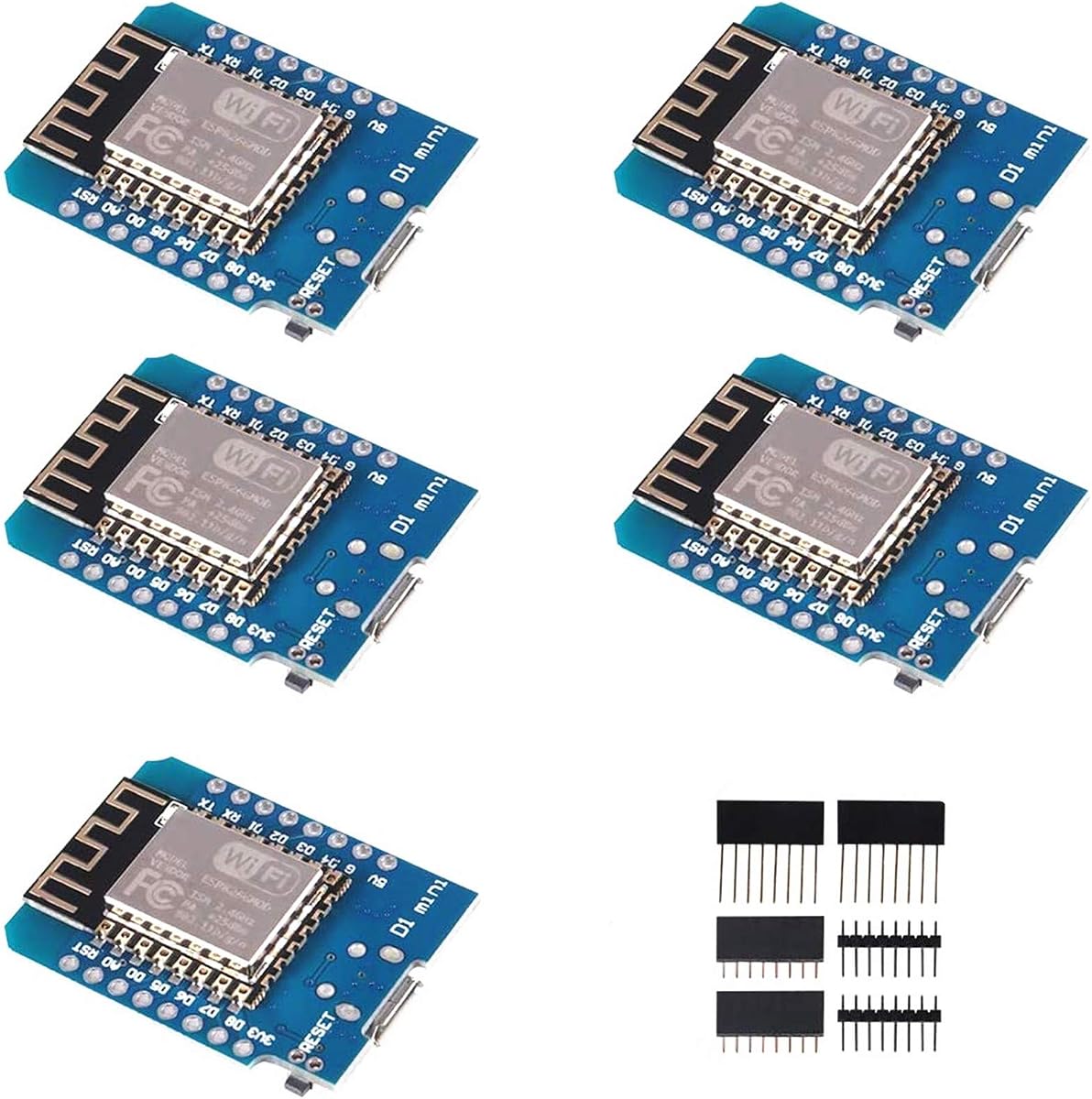
This pack features D1 Mini boards which are easier to use than raw modules. It rates 4.5 stars and breaks out more pins for IO.
We may earn a commission when you buy through this link, at no additional cost to you.
You get 11 digital pins and a onboard 5V switching supply. The Micro USB connection simplifies power and programming significantly.
The 3.3V analog input limit must be respected to avoid damage. This makes it ideal for logic projects.
Buy this for prototyping with more flexible pins. It is the best breakout Arduino WiFi module for hobbyists.
The D1 Mini format breaks out more pins than standard modules allowing direct connection to sensors without extra wiring.
An onboard 5V supply lets you power the board with standard USB adapters while handling logic conversion internally.
We may earn a commission when you buy through this link, at no additional cost to you.
This bulk pack offers ten modules for extensive projects. It rates 5.0 stars and is ideal for large deployments or teams.
We may earn a commission when you buy through this link, at no additional cost to you.
The ESP8266 processing and storage capabilities handle complex algorithms efficiently. All units are compatible with Arduino platforms via serial.
It is perfect for classrooms or manufacturers building sensor networks. The cost per unit drops significantly with this pack size.
Choose this if you need volume for production or teaching. It is the best bulk Arduino WiFi module for large scale use.
Buying a ten pack reduces per unit cost and ensures all devices use identical firmware which is vital for network consistency.
The robust on-board processing makes these suitable for final products rather than just quick prototypes and testing.
We may earn a commission when you buy through this link, at no additional cost to you.
Choosing the right Arduino WiFi module depends on your power needs, connectivity options, and budget.
Modern modules support Wi-Fi 5.0 or Bluetooth 5.0 for better range and speed. Basic ESP modules offer older standards but sufficient for simple tasks.
Always check supported frequencies and protocols to ensure compatibility with your network infrastructure.
Dual-core processors like ESP32 handle multitasking better than single-core ESP8266. Complex applications benefit from higher MHz rates.
Select a board with enough computing power for your data processing requirements to avoid lag.
Many modules only support 3.3V logic. Using 5V without level shifters can destroy the chip permanently.
Ensure your Arduino logic matches the module voltage to prevent hardware damage.
USB-C and Micro-USB simplify programming compared to bare serial pins. Some boards integrate breakout headers for easier wiring.
Choose boards with built-in USB adapters to save time on external circuitry.
Flash memory ranges from 1MB to 4MB. Larger storage allows for more features and file storage on the device.
Higher capacity is recommended if you plan to store configurations locally on the module.
Battery powered projects need low power modes. ESP32 boards often support deep sleep to save energy.
Check power requirements if your device runs on batteries rather than constant USB power.
Buying in packs of 5 or 10 reduces costs. Single units are better for one-off prototypes.
Consider how many units you need to avoid overspending on unused components.
Check if MicroPython or specific libraries are supported. Official boards often have better documentation and community resources.
Strong software support ensures you can find help when troubleshooting issues quickly.
Connect the module to your Arduino using UART pins (TX and RX). Ensure power levels match before applying voltage to prevent damage.
Use the Arduino IDE to select the correct board type or upload generic sketches. Serial terminals help debug connection issues.
Keep modules away from excessive heat and humidity to maintain signal quality. Store them in dry environments when not in use.
Most ESP modules work with any Arduino via serial communication but you need level shifters for 5V boards. Official boards like Nano ESP32 integrate directly with USB-C.
Some boards have onboard regulators that work via USB but bare modules usually need stable 3.3V power. Check if your specific board includes voltage regulation.
Weak signals often stem from interference or distance. Ensure antennas are properly attached and avoid metal casings that block radio waves.
Some boards like Nano ESP32 support MicroPython directly. For others you may need to use specific firmware like MicroPython or C++ sketches in Arduino IDE.
Active transmission uses more power than standby. For battery devices use sleep modes provided by the chip to extend operation time between charges.
Yes most are compatible with platforms like Home Assistant. They can connect to MQTT brokers or web interfaces for smart home control easily.
The Arduino UNO R4 WiFi is easiest due to built-in features and USB-C. Beginners also like the D1 Mini because it has breakout pins for easy wiring.
Modules can act as Access Points (AP) without a router. This lets them create their own local network for direct device communication.
The Arduino UNO R4 WiFi offers the best all-in-one experience with dual-core power and integrated peripherals.
Prioritize processing and connectivity features if your project needs advanced functionality. For simple sensors the ESP8266 modules provide value.
Prices change frequently so check current listings before purchasing to ensure you get the best deal for your needs.