
Network Ethernet Cable Tester for LAN RJ45 RJ11 CAT5 CAT5E CAT6 CAT6A CAT7
4.6Editor score
Fast slow scan modes
Detachable split type design
Shielded cable detection
This guide compares the top 10 Ethernet Cable Tester models for professionals and DIY users, highlighting features, accuracy, and reliability for network
Finding the right Ethernet Cable Tester is crucial for ensuring network connectivity and troubleshooting wiring issues efficiently. Whether you are a network engineer or a homeowner, selecting a reliable tool saves time and prevents costly downtime.
We have evaluated ten top-rated testers based on their testing capabilities, durability, ease of use, and additional features like PoE detection and length measurement. Our comparison covers a wide range of budgets and professional needs to help you make an informed decision.
Each pick in this list showcases specific strengths suited for different scenarios, from basic continuity checks to advanced fiber optic support. Please note that prices and availability change frequently, so check the current listings before purchasing.
4.6Editor score

4.8Editor score

4.5Editor score
The following table provides a side-by-side comparison of all ten Ethernet Cable Tester models, detailing their key specifications, supported cable types, and unique functionalities to assist in your selection process.




The Klein Tools VDV526-200 stands out as a top-tier Ethernet Cable Tester for professionals who need reliability. With a 4.8 rating, it offers precise testing for RJ45 terminated cables and patch cords.
We may earn a commission when you buy through this link, at no additional cost to you.
Its large backlit LCD display ensures clear visibility of wiremap results even in dimly lit crawl spaces or server rooms. The device tests for opens, shorts, miswires, split-pairs, and shield faults effectively.
While the tone generator requires a separate probe, the auto power-off feature helps conserve battery life during extended field use. The interface is intuitive with three buttons for quick operation.
Ideal for network technicians and IT admins, this tester balances performance and portability. It is a solid investment for those who prioritize accuracy and durability in their tool kit.
The backlit LCD makes reading pin-to-pin results easy without needing extra lighting in dark areas.
It identifies split-pair and shield faults that simpler testers might miss, ensuring network integrity.
We may earn a commission when you buy through this link, at no additional cost to you.
This starter set from Klein Tools is designed for broader testing needs beyond just data cables. It handles RJ11, RJ12, and coax connections alongside standard Ethernet wiring.
We may earn a commission when you buy through this link, at no additional cost to you.
One of its strongest features is the extended cable length measurement, which can determine runs up to 2000 feet accurately. This helps installers verify cable specs against project requirements quickly.
The backlit LCD shows length and wiremap results clearly, but it lacks Power over Ethernet testing capabilities. Users must buy an analog probe separately for tracing tasks.
Best for general contractors and home installers, it provides a good balance of voice, data, and video testing. It simplifies cabling projects with clear visual feedback.
The ability to measure long runs accurately helps prevent cable waste and ensures proper installation.
Testing multiple cable types in one device reduces the need to carry separate tools for different jobs.
We may earn a commission when you buy through this link, at no additional cost to you.
The LAN Explorer is a pocket-sized solution for quick continuity checks on voice and data cables. It is ideal for scenarios where you just need to know if a cable is pass or fail.
We may earn a commission when you buy through this link, at no additional cost to you.
Fast LED responses give immediate feedback on wire order and faults like opens or shorts. The test remote stores securely inside the body to prevent loss during travel.
While it lacks an LCD screen for detailed maps, its simplicity makes it easy to use for non-technical staff. The low battery indicator ensures you are not caught off guard.
Perfect for general maintenance or quick checks, this model is cost-effective and reliable. It fits easily in a tool belt or pocket for on-the-go troubleshooting.
Its small footprint allows you to carry it everywhere without adding bulk to your daily gear.
The remote stays safely tucked inside the main unit, preventing misplacement during busy workdays.
We may earn a commission when you buy through this link, at no additional cost to you.
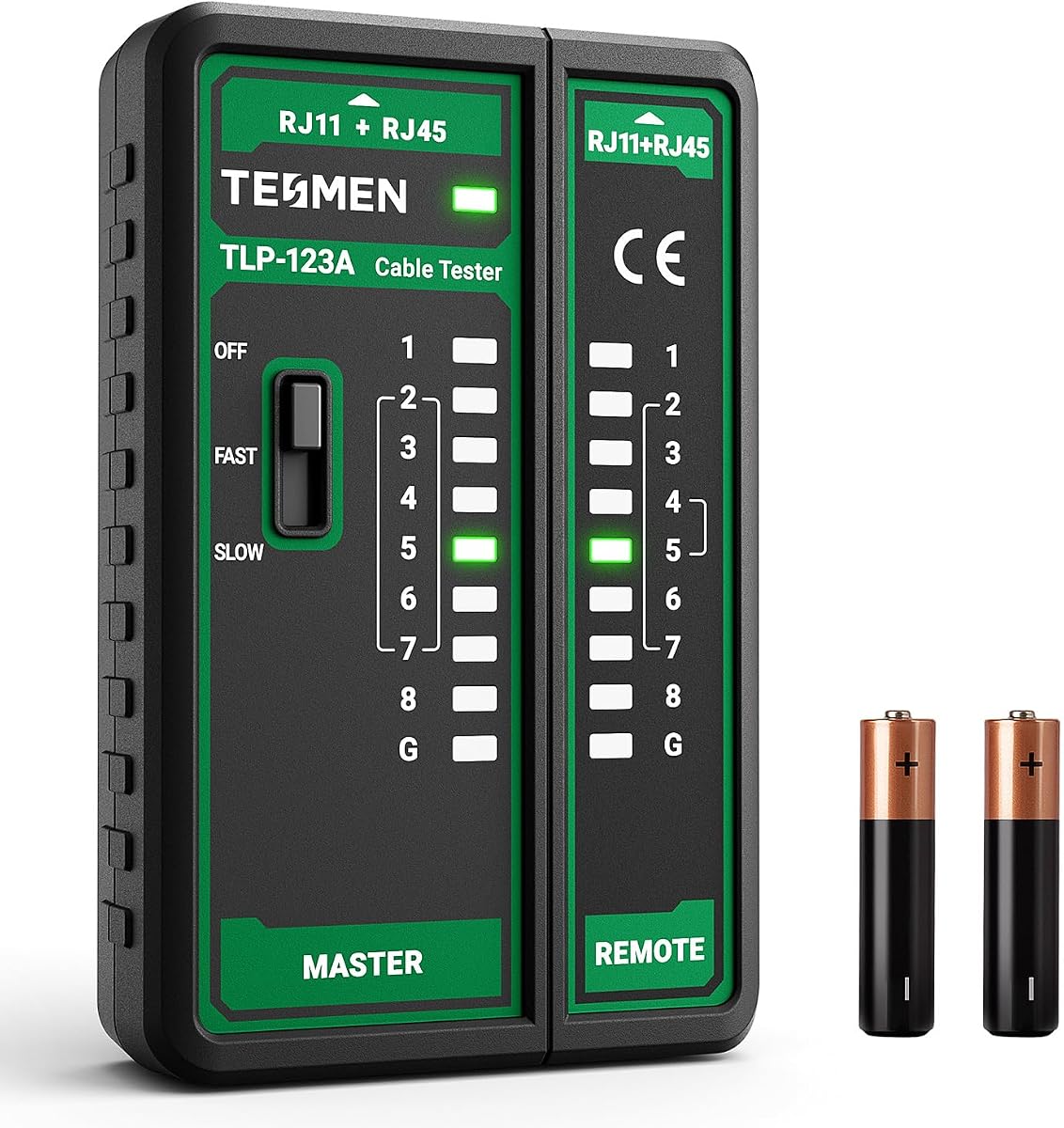
This TESMEN model offers essential testing capabilities for a very competitive price point. It supports a wide range of cable types from CAT5 to CAT7 and handles both UTP and STP.
We may earn a commission when you buy through this link, at no additional cost to you.
The one-button operation makes it extremely easy for home users or beginners to troubleshoot wiring issues. Clear LED indicators show test results without requiring complex interpretation.
The detachable design allows you to test long cable runs by placing units at each end independently. It is a solid choice for budget-conscious buyers needing basic reliability.
Ideal for home wiring and DIY network setups, it ensures continuity and correct wiring without breaking the bank. It is a practical tool for maintaining existing home networks.
This tester provides essential functionality at a fraction of the cost of professional-grade tools.
It can detect shielded status, which is crucial for networks running in noisy environments.
We may earn a commission when you buy through this link, at no additional cost to you.
The HT812A is an affordable option that does not compromise on basic functionality. It supports various Ethernet standards and telephone lines with simple button operation.
We may earn a commission when you buy through this link, at no additional cost to you.
Its ability to switch between fast and slow scan speeds helps in identifying precise wiring issues. The G light instantly tells you if the cable is shielded or unshielded.
Designed to be safe for telephone voltages, it can be used for home phone line repairs as well. The ergonomic ABS housing ensures durability despite its lightweight build.
Best for DIYers and casual users, this tester offers great value for money. It is a reliable companion for ensuring home network connectivity is functioning correctly.
Switching speeds helps pinpoint exact wire order when dealing with long or complex cable runs.
You can safely test telephone lines without worrying about damaging the unit or creating hazards.
We may earn a commission when you buy through this link, at no additional cost to you.
This comprehensive kit adds PoE testing capabilities to the standard data and voice testing features. It displays voltage and wire info for powered devices, which is critical for IP cameras.
We may earn a commission when you buy through this link, at no additional cost to you.
The Self-Storing Test + Map Remote simplifies identification by allowing you to test and map in one step. It includes multiple locator remotes for identifying multiple cable runs simultaneously.
Measuring up to 2000 feet ensures you can verify long cabling runs accurately. The kit is complete with adaptors and jumper cables, ready for professional deployment.
Ideal for structured cabling projects and office setups, it saves time with its identification features. It is a robust solution for network administrators managing complex systems.
Knowing exactly how much voltage is reaching your device helps troubleshoot power failures quickly.
Identifying specific cable runs in a bundle is much easier with multiple unique identifiers.
We may earn a commission when you buy through this link, at no additional cost to you.
This NOYAFA model includes a Non-Contact Voltage pen for detecting live AC lines without direct contact. It offers anti-interference tracing modes for noisy environments.
We may earn a commission when you buy through this link, at no additional cost to you.
The rechargeable transmitter uses a Type-C cable for power, eliminating the need to constantly replace batteries. It also supports port flash testing to verify active connections on switches.
Measuring lengths up to 200 meters is sufficient for most home and office networks. It identifies PoE standards and voltage clearly on the display.
Best for technicians needing a versatile tool for power and data testing, it offers good value. The included tool bag keeps all components organized during transport.
The NCV pen allows safe detection of live wires before touching them with the tester.
Using a rechargeable battery reduces long-term costs and ensures you always have power ready.
We may earn a commission when you buy through this link, at no additional cost to you.
This tester is designed with modern convenience in mind, featuring a Type-C charging port instead of disposable batteries. It supports testing up to 60V for PoE switches.
We may earn a commission when you buy through this link, at no additional cost to you.
The auto power-off feature after 15 minutes of inactivity helps preserve battery life effectively. It can test various Ethernet categories from CAT5 to CAT7 with clear LED feedback.
The simple single-button test makes it very user-friendly for quick diagnostics. It is suitable for both home and industrial fields requiring basic continuity and voltage checks.
For those who prefer eco-friendly devices without frequent battery changes, this is a strong choice. It offers solid performance for daily network maintenance tasks.
Modern charging means you can use the same cable as your phone or other devices.
The device turns off automatically so you do not drain the battery by forgetting to switch it off.
We may earn a commission when you buy through this link, at no additional cost to you.
This unique model combines copper testing with an optical power meter, making it ideal for hybrid networks. It can measure light power levels for fiber optic cables accurately.
We may earn a commission when you buy through this link, at no additional cost to you.
The visual fault locator emits a red laser to find breaks or bends in fiber strands easily. It supports various wavelengths and connectors for comprehensive fiber testing.
For copper testing, it handles length measurement, PoE checks, and continuity. The Type-C charging and long battery life ensure it stays ready for extended projects.
Best for ISPs and advanced network engineers, this tool covers both physical mediums. It simplifies troubleshooting in networks where fiber and Ethernet coexist.
Measuring signal strength helps ensure your fiber links are running within optimal power ranges.
The red laser makes it easy to spot breaks in fiber cables without expensive specialized gear.
We may earn a commission when you buy through this link, at no additional cost to you.
Fluke remains the gold standard for testing tools, and this MicroScanner2 offers precise distance to fault data. It helps locate breaks or shorts without needing to replace entire cable runs.
We may earn a commission when you buy through this link, at no additional cost to you.
The built-in IntelliTone toning allows for precise tracing on live or data networks. It also tests VoIP functionality to ensure voice services are ready.
While expensive compared to basic testers, it is designed for industrial environments where reliability is paramount. The durable yellow casing withstands drops and rough handling well.
Best for enterprise environments and professional installers, it provides confidence in every test. The detailed data display helps resolve complex network issues efficiently.
This feature saves hours by telling you exactly where a break is located in the cable run.
Digital toning ensures accurate tracing even through noisy or high-bandwidth environments.
We may earn a commission when you buy through this link, at no additional cost to you.
Selecting the right Ethernet Cable Tester depends on your specific networking needs, budget, and environment. This guide outlines the key factors to consider.
Ensure the tester supports the specific cable categories you use, such as CAT5e, CAT6, or CAT7. Some models also handle RJ11 and coax, which is useful for hybrid setups.
Check compatibility with UTP and STP cables to ensure accurate results for your specific network infrastructure.
Look for testers that identify opens, shorts, miswires, and split-pair faults. Advanced units may also detect shielding issues which affect performance.
A good tester will clearly display these faults so you can fix them immediately without confusion.
If you install IP cameras or VoIP phones, choose a tester that verifies PoE voltage and wiring. This ensures devices receive power correctly.
Testing PoE helps prevent damage to connected devices caused by incorrect wiring or voltage issues.
Consider how often you will carry the device. Compact models with pocket-sized designs are ideal for on-the-go work, while kits with carrying cases offer better protection.
Ergonomic designs with buttons that are easy to press even while wearing gloves improve usability in the field.
Backlit LCD screens are essential for testing in dark crawl spaces or server racks. Bright LED indicators work well for basic pass/fail checks.
Ensure the display shows information clearly so you can read results without straining your eyes.
Testers that use standard batteries are easy to replace, while rechargeable models reduce long-term waste. Look for auto power-off features to save power.
A battery indicator ensures you know when to replace or charge the unit to avoid interruptions.
Some models can measure the length of a cable run in feet or meters. This is useful for verifying specs or finding breaks within long cables.
Accurate length measurement helps you estimate material needs and troubleshoot signal loss issues.
Features like tone generation, remote identification, and non-contact voltage detection add versatility. Consider which extras you actually need for your tasks.
Extra features should enhance your workflow rather than complicating the basic testing process.
To use your Ethernet Cable Tester, simply plug one end of the cable into the main unit and the other into the remote. Turn on the device and wait for the LED indicators to confirm if the connection is good.
Always clean the connector ports on your tester with a dry brush to remove dust that could affect results. Store the unit in a protective case to prevent damage to the plastic housing and internal components.
Regularly check your battery levels to ensure the device is ready for use. If you plan to keep the device for a long time, remove the batteries to prevent leakage.
A basic cable tester checks for continuity and simple wiring errors like opens or shorts. A verifier offers more advanced features such as length measurement, distance to fault analysis, and VoIP or PoE testing capabilities.
Yes, many advanced models can detect breaks or faults in the wire. Some use time-domain reflectometry to estimate the distance to the break, helping you pinpoint where to repair the cable.
Many modern testers include a built-in tone generator. However, some entry-level models require you to buy a separate probe or tone generator for tracing tasks through walls or conduits.
Most basic testers are designed to test unenergized cables. Some advanced units can handle PoE voltage safely, but always check the manual to ensure the device can handle live power if needed.
Some testers have a specific light or setting that indicates shielding status. If your model does not, you may need to visually inspect the cable for a metallic braid or foil layer.
Most testers use standard 9V or AAA batteries. Newer models may come with rechargeable lithium batteries that charge via USB-C for convenience and cost savings.
We have reviewed ten distinct Ethernet Cable Tester models ranging from budget-friendly options to professional-grade verifiers. Each offers unique features suited for different networking challenges and environments.
When choosing, consider your primary use case, such as home maintenance versus enterprise deployment. Features like PoE testing and accurate length measurement can significantly reduce troubleshooting time.
Always verify current pricing and availability on Amazon before making your purchase. This guide aims to provide the necessary information for selecting a reliable tool.