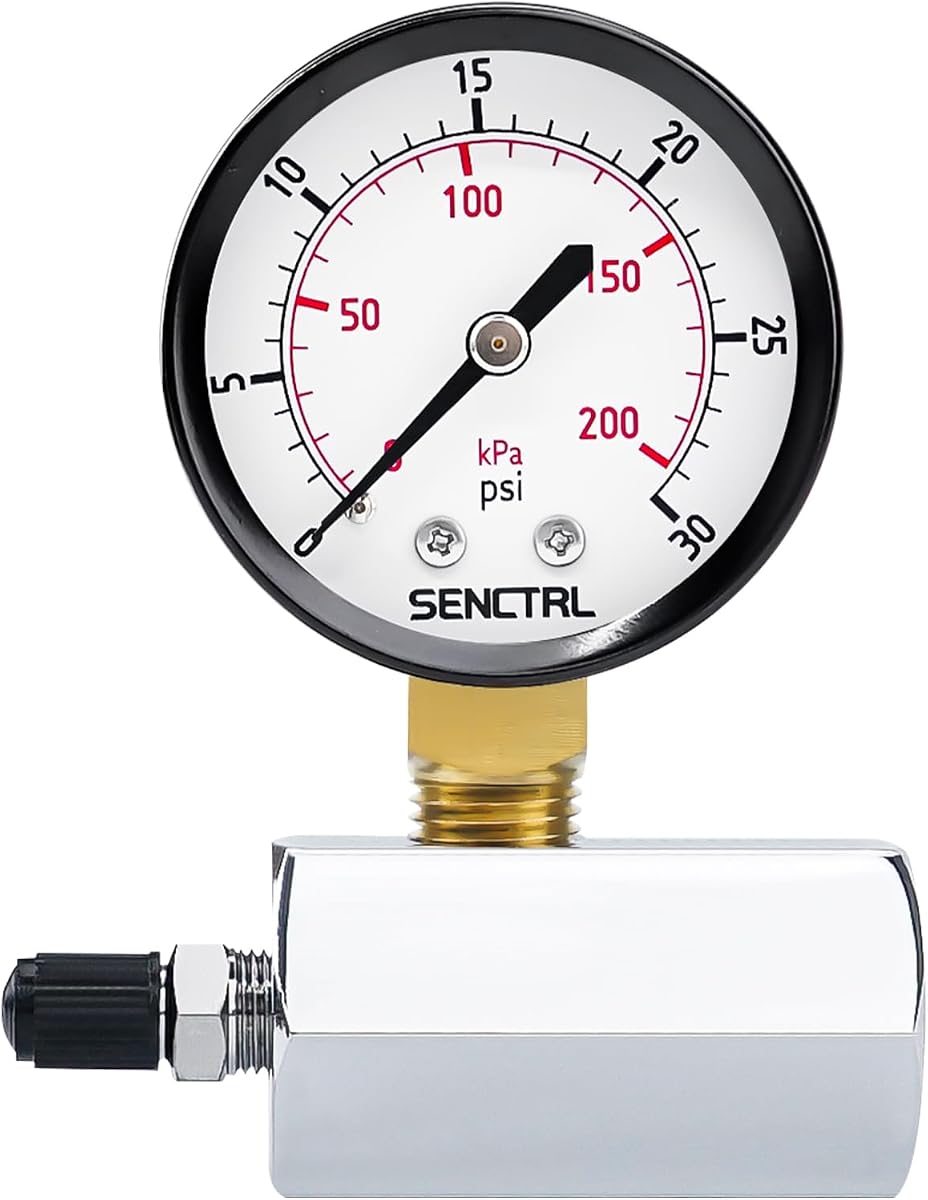
SENCTRL 0-30 Psi Gas Pressure Test Gauge
4.5Editor score
Chrome plated steel body
Dual scale 0-30 psi
3/4 inch FNPT connection
Choosing the right gas line pressure gauge is essential for safety and efficiency when working with natural or propane gas systems. A reliable gauge ensures you can detect leaks, verify proper flow, and maintain optimal appliance performance without guesswork or dangerous errors.
We compared ten leading models based on build quality, accuracy ratings, connection types, and user feedback. Each product was evaluated for its ability to handle specific pressure ranges, resist corrosion, and provide clear readings in various environments from home workshops to professional sites.
Every pick highlights key strengths like valve design, dial size, and material construction. While prices fluctuate frequently, these selections represent the best value and performance available now. Always verify current listings before purchasing to ensure you get the exact specifications you need.
4.5Editor score

4.5Editor score

4.7Editor score
As an Amazon Associate we earn from qualifying purchases.
This side by side comparison highlights the core specifications and capabilities of every model included in this guide. Use these details to match the right tool to your specific gas line testing requirements.


The SENCTRL 0-30 Psi Gas Pressure Test Gauge stands out as an affordable yet reliable option for basic gas line testing. With a rating of 4.5 stars from users, this assembly combines a 2 inch gauge with a chrome plated steel valve body for durability and ease of connection.
We may earn a commission when you buy through this link, at no additional cost to you.
Its primary strength lies in the dual scale design that shows both psi and kPa readings. The chrome plated steel valve body with a 3/4 inch NPT female thread allows for direct attachment to most gas lines without needing extra adapters. The black steel case protects the dial from corrosion and impact.
While it lacks a hose which limits remote readings, the direct connection design ensures minimal leakage points during testing. The accuracy within +/- 3-2-3% is acceptable for most residential and light commercial applications where high precision is not the critical factor.
This gauge is ideal for homeowners or technicians needing a simple tool for checking tank or line pressure. Its low cost and solid construction make it a practical choice for routine maintenance tasks where budget constraints are a priority.
The 3/4 inch FNPT connection eliminates the need for intermediate fittings, reducing potential leak points during testing.
Readings are available in both psi and kPa allowing flexibility for different technical standards or user preferences.
We may earn a commission when you buy through this link, at no additional cost to you.
The Uharbour 30psi Brass Gas Line Pressure Tester offers a durable solution for those prioritizing material longevity. Its forged brass construction ensures superior resistance to corrosion extending the life of the measuring device in humid or outdoor environments.
We may earn a commission when you buy through this link, at no additional cost to you.
A key feature is the 2 inch transparent steel air pressure gauge which enhances reliability and readability. The dual scale for bar and psi makes it easy for diverse teams to interpret results. The brass valve body with cup shaped design adds structural integrity.
Users note that wrapping PTFE tape and tightening parts is essential to avoid any leakage during use. While it does not come with a protective case the brass material itself resists degradation well. The ASME B40.100 accuracy standard adds credibility to its readings.
This tester is well suited for underground and indoor gas lines where corrosion is a concern. It works best for applications needing consistent low pressure measurements without the complexity of additional hoses or complex adapters.
Forged brass construction provides long term resistance to corrosion ensuring reliable performance over years of use.
The dual scale gauge allows for easy reading in both bar and psi units accommodating different technical standards.
We may earn a commission when you buy through this link, at no additional cost to you.
The Gas Test Pressure Gauge 60 Pound is designed for applications requiring a broader pressure range than standard 30 psi units. With a robust 60 psi maximum it handles more demanding testing scenarios without risking damage to the internal bourdon tube type mechanism.
We may earn a commission when you buy through this link, at no additional cost to you.
Its 2 inch pressure gauge features a durable glass lens that remains non fading over time. The brass valve and forged steel bell shape body assembly provide a sturdy structure that withstands field conditions. The dual scale offers both psi and kPa readings.
While the body is sturdier it may require more space during installation compared to slim alternatives. The connection remains standard 3/4 FNPT for compatibility but users should ensure adequate clearance for the larger bell shape design.
Ideal for industrial or commercial gas lines where higher pressures are expected this gauge delivers reliability. Its clear readout and sturdy build make it a practical choice for technicians who need to test beyond standard residential limits.
The 60 psi maximum range allows testing of systems operating above standard residential limits safely and accurately.
The durable non fading glass lens ensures readings remain clear and legible even after prolonged exposure to elements.
We may earn a commission when you buy through this link, at no additional cost to you.
MEASUREMAN is a known name in testing tools and this brass gas pressure test gauge assembly reflects that reputation. The 2.5 inch dial provides a clear view of readings making it easy to interpret pressure levels even in dim lighting conditions.
We may earn a commission when you buy through this link, at no additional cost to you.
Using brass wetted parts ensures compatibility with various gas types without corrosion issues. The dry internal movement helps maintain accuracy over time by preventing fluid related failures. It connects directly via 3/4 NPT female thread for quick setup.
The black steel case adds protection against bumps and scrapes common on job sites. While it does not include a hose it remains a straightforward unit for fixed testing points. Its accuracy of +/- 3-2-3% aligns with industry standards for this class of gauge.
This assembly is recommended for users who prioritize brand reliability and straightforward functionality. It fits well in existing gas testing kits where additional hoses are already available or when direct connections are preferred for stability.
MEASUREMAN offers consistent quality control ensuring reliable performance and accuracy over years of regular use.
The 3/4 NPT connection is widely used making this gauge easy to integrate into most existing gas line setups.
We may earn a commission when you buy through this link, at no additional cost to you.
The BETOOLL Fuel Pressure Test Kit offers exceptional versatility with its range of adapters for different fuel line sizes. It includes 9.49mm, 7.89mm, and 6.30mm fittings allowing compatibility with many engine configurations. The double scale gauge reads 0 to 7 bar and 0 to 100 psi.
We may earn a commission when you buy through this link, at no additional cost to you.
High quality brass connectors and a corrosion resistant rubber hose ensure the kit lasts through demanding conditions. It is designed for any engine requiring fuel pressure diagnostics to identify leaks or regulator faults. The gauge face is clear for easy reading during operation.
Important to note is that this kit should never be used on diesel engines as specified in the notes. While it provides high pressure capacity it is specifically tuned for fuel system testing rather than general gas lines. The adapters allow flexible connection options.
This kit is ideal for automotive technicians diagnosing fuel pump or filter issues. Its high range and multiple adapters make it a robust tool for detailed engine maintenance where precision and adaptability are key for accurate diagnosis.
Multiple fuel line fittings allow this kit to connect to various engine types ensuring broad diagnostic capabilities.
The kit is designed specifically for fuel systems enabling accurate detection of leaks and regulator malfunctions.
We may earn a commission when you buy through this link, at no additional cost to you.
The MEASUREMAN Natural Gas or LP Gas Manifold Pressure Test Kit is an excellent choice for detailed appliance manifold testing. Its 0 to 35 inch W.C. range is perfect for low pressure gas lines found in most household appliances. The 40 inch hose allows testing without moving the unit.
We may earn a commission when you buy through this link, at no additional cost to you.
Key components include a brass movement and connection plus a beryllium diaphragm capsule for sensitivity. The 2.5 inch dial is protected by a snap on acrylic window. It comes in a mould plastic box ensuring all parts stay organized and protected from damage.
The lower mount design facilitates easy reading while working under appliances. Accuracy remains within +/- 3-2-3% for reliable data. While specific to low pressure applications it handles both natural and LP gas effectively making it versatile for home services.
This kit is recommended for professional technicians focusing on HVAC or gas appliance installation. Its included storage case and long hose make it ready for on site diagnostics ensuring accurate pressure verification for safe appliance operation.
The 40 inch hose allows technicians to read gauges from a safe distance during manifold pressure testing.
The beryllium diaphragm capsule ensures high sensitivity for accurate low pressure readings across appliance manifolds.
We may earn a commission when you buy through this link, at no additional cost to you.
The DANCO Gas Test Gauge is designed for precision when working with tank pressures up to 15 psi. It measures in 1/10th increments allowing for fine tuned pressure adjustments. This makes it valuable for specific tasks requiring high resolution readings.
We may earn a commission when you buy through this link, at no additional cost to you.
The gauge features a clear facing to help see measurements with ease. Its chrome plated body and sturdy steel case provide safety and durability in demanding environments. It fits onto 3/4 inch MPT threads for standard connections.
While the range is limited to 15 psi it excels where low pressure detail is needed. The plastic face resists breaking. Users should ensure proper sealing when connecting to avoid minor leaks during testing. Accuracy remains reliable within its small range.
This gauge is ideal for technicians working on propane tanks or similar low pressure systems. Its fine increments allow precise calibration and leak detection ensuring safety and efficiency in gas line operations without unnecessary complexity.
Measuring in 1/10th increments allows for precise pressure adjustments critical for small tank systems.
The chrome plated body and sturdy steel case ensure safe and reliable performance during field testing.
We may earn a commission when you buy through this link, at no additional cost to you.
The MEANLIN MEASURE Manifold Gas Pressure Test Kit stands out with the highest rating of 4.7 stars for its versatile and robust design. It includes multiple hex bushings and a barbed connector ensuring solid connections to various gas systems. The zero adjustable setting allows for precise calibration.
We may earn a commission when you buy through this link, at no additional cost to you.
Equipped with a 40 inch hose it meets needs for different scenarios requiring reach. The temperature range spans 32 to 131 degrees F making it suitable for diverse climates. The dial face is easy to read with a snap on window for protection.
While the NPT thread size is nominal the included adaptors ensure fit across systems. This kit is more complex than basic gauges but offers superior flexibility. It is built for professionals who need reliable low pressure readings in varied conditions.
This premium kit is recommended for advanced HVAC or gas service technicians. The combination of adjustable zero multiple connectors and long hose provides unmatched versatility. It ensures accurate and stable readings essential for complex manifold testing.
The zero adjustable setting allows for precise calibration ensuring accurate readings across different pressure conditions.
Multiple hex bushings and barbed connections make this kit adaptable to various gas systems seamlessly.
We may earn a commission when you buy through this link, at no additional cost to you.
The Boltigen Fuel Pressure Gauge features a glycerin filled design which ensures accurate and stable readings even in vibrating environments. With a range of 0 to 15 psi it is suited for low pressure fuel systems. The inline design provides visibility during operation.
We may earn a commission when you buy through this link, at no additional cost to you.
Its body is made from high quality stainless steel and brass ensuring durability and corrosion resistance. The kit includes 3/8 and 5/16 inch brass barb fittings for compatibility with different fuel system configurations. Attached clamps make installation convenient.
The gauge is designed for center back mount installation providing accessibility. It is suitable for automotive marine and industrial fuel system applications. While the range is limited it offers stable performance where vibration might otherwise affect accuracy.
This kit is ideal for mechanics monitoring fuel pressure in engines. The glycerin fill dampens needle movement making readings clearer. Its sturdy build and versatile fittings make it a reliable solution for various fuel system monitoring needs.
Glycerin filled gauge dampens vibrations ensuring stable needle movement for precise pressure readings.
The inline design allows for easy monitoring of fuel pressure while the engine is in operation.
We may earn a commission when you buy through this link, at no additional cost to you.
The OTC 5630 Fuel Pressure Test Kit is built for durability and safety with a large easy read gauge inside an impact resistant rubber encased housing. It quickly locates malfunctioning fuel components without removing them from the vehicle saving time during diagnostics.
We may earn a commission when you buy through this link, at no additional cost to you.
Its 0 to 100 psi range with 0 to 700 kPa offers broad compatibility. High quality solid brass fittings and tubing ensure long lasting performance and reliability. A convenient pressure relief valve allows for safe and clean testing to protect both equipment and user.
While it is heavier than plastic alternatives the rubber housing protects against drops and rough handling. It is ideal for professional workshops where equipment takes regular abuse. The clear gauge face ensures readings are legible even in dim garage conditions.
This kit is recommended for mechanics needing a robust tool for fuel system diagnostics. Its relief valve and impact housing prioritize safety and longevity making it a trusted choice for heavy duty service environments.
The pressure relief valve enables safe and clean testing protecting both the user and the vehicle components.
The rubber encased housing protects the gauge from impacts ensuring durability in professional workshop settings.
We may earn a commission when you buy through this link, at no additional cost to you.
Selecting the right gas line pressure gauge depends on the specific type of gas system you are testing and the precision required for your task.
The pressure range is the most critical factor when choosing a gauge. Residential natural gas systems often operate around 7 inches of water column while propane tanks can reach up to 15 psi. Industrial lines may require gauges that measure up to 60 psi or more. Always ensure the gauge's maximum rating exceeds your expected pressure to avoid damage.
Choose a gauge with a range that covers your maximum expected pressure without being excessively high for accuracy.
Connection types vary between models and must match your gas line threads. Common sizes include 3/4 inch NPT female or male. Some kits include adaptors like hex bushings or barb fittings for flexibility. Check your specific pipe size to ensure a secure leak free fit.
Verify that the gauge connections match your gas line threads to avoid leaks or the need for extra adapters.
Materials like brass and steel offer excellent corrosion resistance essential for gas applications where exposure to moisture occurs. Forged brass bodies tend to last longer than plastic equivalents. The case should be sturdy enough to protect the dial from physical impacts during field work.
Select models with brass wetted parts and a durable case to ensure longevity and resistance to corrosion.
Most standard gauges offer accuracy within +/- 3-2-3% of full scale. For precise appliance adjustment look for models with tighter tolerances or adjustable zero settings. Accuracy ensures safety by confirming pressure levels are within safe operating limits.
Prioritize gauges with clear accuracy ratings that meet the precision needs of your testing requirements.
A larger dial face makes it easier to read values quickly especially in low light conditions. Look for clear markings and dual scales in psi and kPa for flexibility. Protective glass or acrylic lenses prevent breakage and maintain clear visibility over time.
Choose a model with a large clear dial face to ensure easy reading in various environments.
Some kits come with hoses, cases, or adaptors which add value and convenience. A long hose allows for testing from a distance improving safety. Protective cases keep components organized and prevent damage during storage. Consider what you already have before buying.
Look for kits that include necessary hoses or cases to save on additional accessory purchases.
Distinguish between fuel pressure testers for engines and gas line gauges for heating systems. They are not interchangeable due to different fluids and pressure profiles. Ensure the product description explicitly states compatibility with natural gas or propane if needed.
Confirm the gauge is designed for gas systems rather than fuel systems to ensure safety and accuracy.
Reviewing user feedback provides real world insights into durability and performance. Look for comments about leaks, accuracy consistency, or ease of connection. High ratings from verified buyers help validate the manufacturer's claims about the product.
Check customer reviews for consistent positive feedback on durability and ease of use before purchasing.
Before using the gauge ensure all connections are tight and sealed with PTFE tape to prevent any gas leakage during testing. Attach the gauge securely to the test port or valve of the gas line.
Open the gas valve slowly to allow pressure to build gradually while watching the gauge dial. Record the stable reading and compare it to the expected pressure values for your system to verify proper operation.
After testing close the valve and release any remaining pressure safely. Store the gauge in a dry place away from extreme temperatures to preserve accuracy and extend its lifespan.
A gas line pressure gauge is used to measure the pressure of natural gas or propane within a pipeline or tank. It helps technicians verify that the system is operating within safe limits and detect any leaks that may cause pressure drops during testing.
Gas lines should be tested regularly as part of routine maintenance or whenever a new appliance is installed. Testing before seasonal use ensures there are no leaks. Any changes to the system require a new pressure test to confirm safety.
Gas pressure gauges typically display readings in psi (pounds per square inch) or inches of water column (W.C.). Some models offer dual scales including kPa to accommodate different technical standards and user preferences across regions.
No fuel pressure gauges are not recommended for gas lines as they are calibrated for liquid fuel systems which operate under different conditions. Always use a gauge designed specifically for natural gas or propane to ensure accurate and safe readings.
A zero reading may indicate an open gas valve or a blockage preventing pressure build up. Ensure all valves are properly closed during the test. If the valve is open pressure will drop to zero which is normal for open systems.
NPT stands for National Pipe Taper and refers to standard pipe thread sizes used in the US. MPT means Male Pipe Taper. Knowing which type your pipe uses ensures you select the correct gauge fitting to avoid leaks during testing.
Wipe the exterior with a damp cloth to remove dirt. Avoid using harsh chemicals that may damage the dial or case. Do not submerge the gauge in water to protect the internal mechanism from moisture damage during cleaning.
If the gauge is damaged or drops heavily it may lose calibration. Do not use it for testing safety critical systems. Replace it with a new verified gauge to ensure accurate readings and maintain the safety of your gas line.
Choosing the right gas line pressure gauge ensures safety and reliability in your gas system maintenance. The models reviewed provide a range of options from basic direct connect units to advanced kits with hoses and adaptors.
Prioritize the correct pressure range and connection type for your specific gas line to avoid unnecessary adapters. High quality materials and clear readability are essential for consistent performance across various testing environments.
Always verify the current price and availability before purchasing to ensure you receive the exact model you need. These selections offer reliable performance for both home users and professional technicians working with gas systems.