
EinScan Rigil
4.9Editor score
Wireless all-in-one solution
Hybrid laser and IR tech
Built-in high power computing
Discover the top 3D scanner for reverse engineering in October 2026. We compare accuracy, speed, and features across ten leading models for professionals.
Reverse engineering requires precise digital captures of physical objects. A high-quality 3D scanner for reverse engineering ensures engineers can recreate parts with exact dimensions and surface details efficiently.
We evaluated ten top models based on precision, scanning speed, software compatibility, and ease of use. Our analysis focuses on industrial-grade capabilities needed for professional engineering and manufacturing workflows.
Each pick highlights specific strengths for different needs and budgets. Prices and availability change frequently, so verify current details before purchasing to ensure you get the best value for your project requirements.
4.9Editor score

4.8Editor score

4.7Editor score
This side-by-side comparison highlights key specifications across ten leading scanners. Reviewing these metrics helps you match technical capabilities with your specific reverse engineering needs.



The Revopoint MetroX Pro stands out as a top-tier 3D scanner for reverse engineering tasks. It delivers industrial-grade blue laser scanning with precision up to 0.01 mm, making it ideal for detailed modeling and quality inspection.
We may earn a commission when you buy through this link, at no additional cost to you.
Its four scanning modes cover diverse needs, from flat shiny surfaces to fine features. The device streams scan data to mobile devices in real time, allowing engineers to monitor progress without holding a laptop during operations.
While powerful, the software ecosystem requires separate purchases for advanced tools like Revo Design. Users should factor in these costs when planning a complete workflow for professional reverse engineering projects.
Engineers and designers seeking high accuracy and efficiency will find this scanner invaluable. It balances performance with flexibility, making it a strong choice for industrial and creative applications alike.
Blue lasers enable accurate captures on challenging surfaces without spray. This ensures clean data for engineering analysis and reduces preparation time significantly.
Real-time mobile streaming frees users from tethered setups. You can inspect data gaps instantly and adjust scanning paths dynamically.
We may earn a commission when you buy through this link, at no additional cost to you.
The Revopoint MetroY Ultra offers exceptional speed with up to 90 FPS scanning powered by NVIDIA GPUs. This makes it suitable for rapid reverse engineering tasks where time is critical without sacrificing detail quality.
We may earn a commission when you buy through this link, at no additional cost to you.
It features industrial-grade blue laser technology ensuring accuracy up to 0.01 mm single frame. Wireless support via Wi-Fi 6 and a long-lasting battery grip allow uninterrupted scanning sessions outdoors or in remote locations.
Though fast, the device requires robust hardware for optimal performance. Users should ensure their systems meet specifications to handle the data throughput effectively during large scans.
Professionals needing speed and mobility will appreciate this scanner. Its combination of high frame rates and environmental adaptability suits complex industrial inspection and reverse engineering workflows.
90 FPS speeds reduce acquisition time significantly. This boosts productivity when scanning large or complex components quickly.
Battery grip and sunlight compatibility enable outdoor use. You can capture industrial parts even in harsh lighting conditions effectively.
We may earn a commission when you buy through this link, at no additional cost to you.
The EinScan Rigil represents a premium wireless solution for reverse engineering with onboard computing and Wi-Fi 6. Its hybrid blue laser and IR VCSEL technology delivers precise captures without external PC dependency for many tasks.
We may earn a commission when you buy through this link, at no additional cost to you.
Featuring 50 laser lines and high power specs, it handles dark reflective surfaces easily. The built-in touchscreen and replaceable batteries support extended field work, ensuring flexibility in diverse environments.
While powerful, the device comes at a premium price point. However, the inclusion of training and a comprehensive package adds value for users requiring immediate deployment.
Experts needing autonomous scanning with high fidelity will find this ideal. Its wireless freedom and processing power redefine portability for professional reverse engineering applications.
Onboard computing eliminates cable constraints entirely. You get full control over scanning without external computer tethering.
Hybrid sources ensure precision on all materials. Black or shiny metal parts scan accurately without prep sprays.
We may earn a commission when you buy through this link, at no additional cost to you.
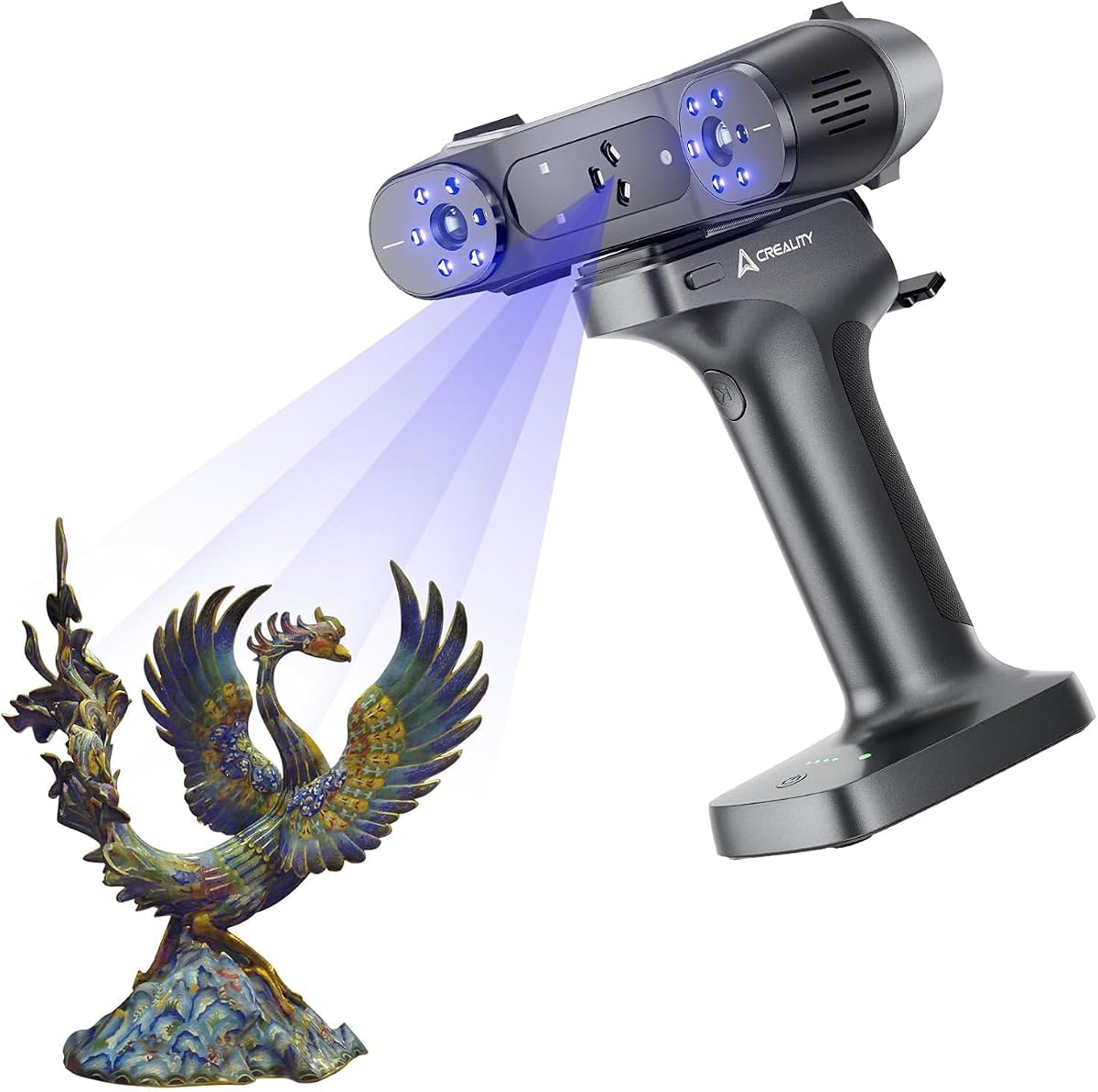
The Creality CR-Scan Raptor Pro combines high speed and versatility for reverse engineering. With 22 crossed and 7 parallel blue lasers, it captures details quickly on medium to large objects effectively.
We may earn a commission when you buy through this link, at no additional cost to you.
Its all-weather performance and material versatility allow direct scanning of black and metal items. True color rendering and compatibility with major 3D design software ensure smooth workflows from scan to final model.
While robust, optimal performance relies on specific computer configurations. Users should check GPU and RAM requirements before purchase to avoid bottlenecks during processing.
Professionals seeking a balanced industrial tool will appreciate this scanner. Its speed and adaptability make it well-suited for automotive and general engineering tasks.
Blue laser tech handles dark and metallic surfaces. This simplifies prep by eliminating powder spraying steps.
Seamless integration with design tools aids workflows. You can export formats compatible with industry standard software.
We may earn a commission when you buy through this link, at no additional cost to you.
The Revopoint INSPIRE 2 offers a lightweight option for portable reverse engineering tasks. At just 190 grams, it is easy to carry for on-the-go inspections requiring reasonable precision.
We may earn a commission when you buy through this link, at no additional cost to you.
Wireless support and infrared laser lines allow capturing details on reflective surfaces without spray. Its optical zoom helps focus on mixed geometry, while full-color texture capture adds realism to models.
Accuracy remains adequate for general modeling but less than high-end metrology tools. Users prioritizing portability over extreme precision will find this fits their needs well.
Field technicians and hobbyists should consider this device. It balances weight and functionality effectively for smaller reverse engineering projects.
Ultra-light design enables extended handheld use. You can scan without fatigue during long sessions outdoors.
Operates in shaded environments reliably. This extends usability beyond controlled indoor lab settings.
We may earn a commission when you buy through this link, at no additional cost to you.
The Creality Otter Lite Basic provides an accessible entry into reverse engineering. With 0.05mm resolution, it delivers professional-grade accuracy suitable for DIY and smaller industrial tasks.
We may earn a commission when you buy through this link, at no additional cost to you.
Dual-mode scanning supports close and long-range captures. The complete kit includes turntable, calibration board, and markers, enabling immediate use upon arrival without extra purchases.
While cost-effective, it targets smaller objects compared to industrial scanners. Hobbyists and students needing reliable precision without high expenses will appreciate its value.
Budget-conscious users should choose this model for simplicity. It offers strong foundational features for learning and basic engineering applications.
High resolution at low cost aids entry. You get accurate data without expensive industrial hardware.
Included accessories streamline initial setup. Users can begin scanning immediately after unboxing.
We may earn a commission when you buy through this link, at no additional cost to you.
The Revopoint MetroX Pro standard version offers robust blue laser capabilities for reverse engineering. Its single-frame precision of 0.01 mm meets industrial measurement needs efficiently.
We may earn a commission when you buy through this link, at no additional cost to you.
Three tracking modes and auto turntable scanning simplify complex shape capture. Real-time streaming to mobile devices aids inspection, while multiple modes handle diverse surface types seamlessly.
Independent software tools enhance post-processing but require separate licenses. Users should budget for these to fully leverage the scanner's engineering potential.
Professionals needing reliable industrial performance will favor this model. It provides consistent accuracy for modeling and inspection workflows.
Advanced lasers capture details accurately. This ensures quality data for precise reverse engineering.
Real-time streaming aids inspection. Users detect data gaps instantly during operation.
We may earn a commission when you buy through this link, at no additional cost to you.
The Creality Raptor Pro achieves metrology grade accuracy up to 0.02mm. Its advanced laser configuration ensures fast captures on medium to large objects efficiently for engineering tasks.
We may earn a commission when you buy through this link, at no additional cost to you.
It operates outdoors without degradation, handling up to 100,000 lux. The CrealityScan app simplifies data processing, offering features like global marker scanning and face/body modes for diverse applications.
Optimal use depends on system recommendations. Users should verify their computer meets specs to ensure smooth scanning and processing performance.
Industrial professionals requiring outdoor flexibility will find this compelling. It balances high accuracy with environmental robustness for versatile workflows.
Designed for harsh sunlight conditions. You can scan outside without quality loss.
One-click processing aids efficiency. Users refine models quickly after capture.
We may earn a commission when you buy through this link, at no additional cost to you.
The Creality Raptor X delivers high-resolution scanning with 34 cross blue laser lines. Its anti-shake technology ensures smooth handheld use, maintaining accuracy on complex parts.
We may earn a commission when you buy through this link, at no additional cost to you.
Wi-Fi 6 wireless transmission enables quick data transfer without cables. The large capacity battery supports extended use, ideal for continuous field work or detailed inspections.
While premium, the device offers excellent wireless convenience. Users seeking speed and mobility should weigh the cost against workflow benefits.
Professionals prioritizing wireless efficiency will find this valuable. It combines high accuracy with modern connectivity features effectively.
Wi-Fi 6 ensures fast data. You avoid cables for uninterrupted scanning sessions.
Large capacity supports long sessions. Field work remains uninterrupted by power needs.
We may earn a commission when you buy through this link, at no additional cost to you.
The Creality Raptor Pro provides high-precision metrology-grade scanning suitable for reverse engineering. Its blue and IR laser combo handles varied surfaces including black and metal effectively.
We may earn a commission when you buy through this link, at no additional cost to you.
Wireless support adds flexibility for industrial inspections. The software offers real-time preview and adjustable resolution, aiding seamless processing from capture to design.
Users must ensure their systems meet requirements for best results. Proper setup ensures smooth operation and optimal data quality during professional use.
Engineering teams needing consistent precision should choose this model. It supports diverse needs from artifact to automotive scanning accurately.
0.02mm precision meets industrial standards. Data remains reliable for critical engineering tasks.
Laser combo handles varied surfaces. You get consistent results across different material types.
We may earn a commission when you buy through this link, at no additional cost to you.
Selecting the right 3D scanner requires balancing accuracy, speed, and workflow compatibility. This guide outlines key factors to consider for professional reverse engineering.
For reverse engineering, accuracy determines the fidelity of the digital model to the physical object. Look for scanners with single-frame precision below 0.05 mm for detailed parts and volumetric accuracy validated by calibration standards.
Prioritize metrology-grade devices for critical industrial applications where tolerances matter. Ensure the scanner's specs align with your project's dimensional requirements to avoid rework.
Higher frame rates reduce scanning time, especially for large or complex components. Models offering 60 FPS or above enable faster data acquisition, improving overall workflow efficiency in production environments.
Balance speed with resolution. While fast capture is beneficial, ensure it does not compromise detail quality needed for accurate reverse engineering reconstruction.
Reverse engineering often involves shiny, dark, or reflective surfaces like automotive parts. Blue laser or structured light scanners can scan these materials without spray powder, saving preparation time.
Verify the scanner's ability to handle challenging textures. Models with infrared or hybrid light sources provide better versatility across different industrial materials.
Software capabilities determine how well captured data translates into usable CAD models. Check for support of standard formats like STL, OBJ, and PLY, and compatibility with design tools like SolidWorks or Rhino.
Consider the total cost of ownership, including any paid software for post-processing or reverse engineering. A streamlined workflow reduces friction between scanning and design.
Wireless scanners offer flexibility for field inspections or tight spaces where cables are impractical. Wi-Fi 6 support enables fast data transfer without compromising mobility.
Assess battery life and weight. Lightweight designs with long-lasting batteries are essential for extended use outside of controlled lab environments.
Ensure the scanner covers the size range of your typical objects. Some models excel at small parts while others handle large assemblies like car bodies or machinery components effectively.
Check minimum and maximum scanning distances to match your workspace. Versatile scanners with multiple modes accommodate varied project scales efficiently.
Full-color texture mapping adds visual fidelity useful for heritage preservation or product design. High-resolution RGB cameras capture surface details beyond geometry for realistic digital twins.
Determine if color data is necessary for your workflow. For pure reverse engineering of shapes, geometry accuracy may take precedence over color fidelity.
Industrial-grade scanners range significantly in cost. Factor in not just the hardware but also training, calibration, and maintenance support when budgeting for a long-term solution.
Choose vendors with reliable customer service and warranty options. Access to updates and technical assistance ensures continued performance over the device lifespan.
Begin by calibrating the scanner using the provided board before each session. Proper calibration ensures data accuracy and minimizes errors during reverse engineering reconstruction.
During scanning, maintain consistent speed and overlap between scan frames to avoid gaps. Use tracking modes like feature or marker tracking to stabilize data capture on complex parts.
After capturing, clean the scanner lens gently and store it in a protective case. Regular maintenance extends device life and keeps optical components in optimal working condition.
The best scanner depends on your specific needs. For high precision, industrial models like the Revopoint MetroX Pro excel. For portability, wireless options like the EinScan Rigil are ideal.
Yes, many modern scanners with blue laser technology can scan shiny metal without spray. Ensure the model supports reflective surfaces for clean data capture.
Advanced software helps convert scans into CAD models. Some scanners include basic tools, but professional workflows often require dedicated design packages.
High-end consumer models offer up to 0.05 mm accuracy, suitable for prototyping. Industrial scanners reach sub 0.02 mm precision for strict engineering tolerances.
Wireless adds flexibility for field work but depends on connection stability. It is beneficial for mobility but wired setups may offer faster data transfer.
Calibrate before critical sessions or after moving the device. Regular checks maintain accuracy and prevent data drift during reverse engineering tasks.
The ten scanners reviewed provide diverse options for every reverse engineering need from budget-friendly entry models to premium industrial solutions. Selecting based on precision and workflow ensures successful digital replication.
Prioritize accuracy, material compatibility, and software integration when choosing. These factors directly impact the quality and usability of your captured data for engineering.
Prices and specs may change, so verify the latest details before buying. Regular updates ensure your technology meets evolving reverse engineering standards effectively.